

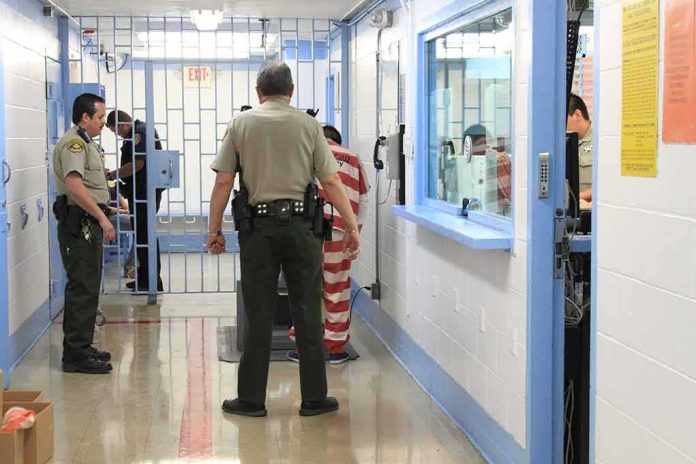
U.S. Immigration and Customs Enforcement (ICE) arrested 10,000 people in just five days at the end of June 2026, averaging 2,000 arrests per day — a pace that dwarfs anything seen in recent memory and signals a sharp new gear in Trump’s deportation machine.
Story Snapshot
- ICE made roughly 10,000 arrests from June 26 to June 30, 2026, averaging 2,000 per day across the country.
- The Department of Homeland Security claims nearly 70% of those arrested had criminal charges or convictions.
- ICE detention beds climbed to about 39,000 in June, up sharply from around 30,000 per month since February.
- The arrest figures come from an anonymous source with unreleased data, and the criminal histories of those detained have not been publicly verified.
The Numbers Behind the Five-Day Surge
The five-day operation ran from June 26 to June 30, 2026. An anonymous source familiar with unreleased data provided the 10,000 arrest figure to multiple outlets, including ABC News and the Associated Press. Federal officials also reported that deportations are now averaging more than 3,200 per day. To put that in context, ICE made about 110,000 total arrests in all of fiscal year 2016. The current pace, if held, would blow past that number in weeks.
ICE detention beds tell the same story. The number of people held in ICE facilities climbed to roughly 39,000 in June, up from about 30,000 per month earlier this year. That jump tracks with the White House ordering ICE to hit at least 2,000 arrests per day, a policy-driven target rather than a response to a specific criminal event. The enforcement engine is running at full throttle, and the White House is the one pressing the gas pedal.
DHS Claims Most Arrests Target Criminals — But the Data Is Not Public
The Department of Homeland Security says nearly 70% of ICE arrests involve illegal immigrants charged or convicted of a crime in the United States. That claim carries real weight if true. It means the bulk of those swept up have rap sheets — not just immigration violations. But here is the catch: the criminal histories of the specific 10,000 people arrested in this surge have not been released or independently verified. The 70% figure is a DHS spokesperson’s claim, not a public dataset anyone can check.
That gap matters. Separate data from the Syracuse University-based immigration tracking project shows that as of April 2026, roughly 70% of all ICE detainees nationwide had no criminal conviction on record. That is the broader detention pool, not this specific operation, but it raises a fair question: are the administration’s criminal-focused claims holding up across the board, or are they selectively true? Demanding a public release of the June 26-30 arrest logs would settle the debate fast. Until then, both sides are arguing over numbers nobody outside the government can fully see.
What the Evidence Actually Shows About Who Gets Arrested
The strongest case for targeted enforcement comes from specific operations with named suspects and documented charges. ICE’s Operation Reclaim and Rebuild, for example, resulted in more than 600 arrests and the rescue of 170 human trafficking victims across multiple California cities. Those are real people pulled out of a genuine criminal network. Critics cannot wave that away. But the broader picture is messier. Brookings Institution researchers note that about one-third of people arrested by ICE do not have a criminal record. ICE also made arrests at immigration court check-ins, despite a judge’s order prohibiting exactly that.
ICE Arrests Surge to 10,000 in Five Days with Focus on Criminals — The operation from June 26-30 averaged 2,000 arrests/day, up from around 1,000 before, w/ nearly 70% involving people charged or convicted of U.S. crimes like murder, rape, and gang activity. Detention numbers…
— Monty's Garden (@MontysGarden) July 5, 2026
The warrantless home raid issue adds another layer. House Judiciary Democrats cited a May 2025 memo signed by the ICE acting director that authorized warrantless home entries. That is a Fourth Amendment problem that courts will eventually sort out, but it also hands critics a legitimate procedural argument. Strong enforcement of immigration law is both justified and necessary. Doing it in ways that invite court reversals and erode public trust is not smart strategy — it is sloppy execution that undermines the mission.
The Bigger Picture: Enforcement at a Scale Not Seen in Decades
ICE has deported roughly 540,000 people since President Trump began his second term in January 2025. The agency now has a goal of deporting one million people per year and is offering $50,000 signing bonuses to double its workforce. Immigration enforcement is operating at a scale not seen in modern American history. Whether you see that as long-overdue accountability or dangerous overreach depends largely on whether you trust the government’s criminal-targeting claims — claims that, so far, remain backed by anonymous sources and unreleased data. That transparency gap is the one thing both sides should be able to agree needs to close.
Sources:
thegatewaypundit.com, abc7.com, truthout.org, instagram.com, facebook.com, latimes.com, tracreports.org