
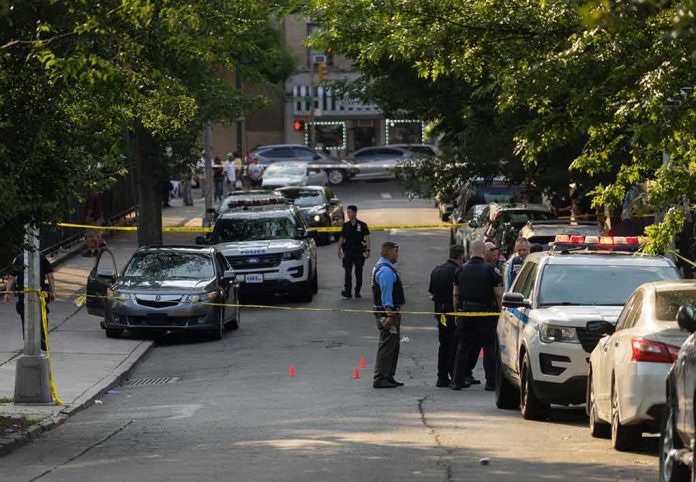
A gunman in camouflage opened fire outside a Montreal grocery store, turning a normal Monday into a citywide test of what “public safety” really means when bullets are flying.[3]
Story Snapshot
- Three people are dead: a police officer, a civilian, and the gunman.[1]
- Montreal blasted a shelter-in-place alert across phones, radio, and TV as the threat unfolded.[1][6]
- Police rushed toward the shooter instead of waiting, following modern active-shooter playbooks.[11][19]
- Officials now say the suspect acted alone and the immediate threat is over, but the motive gap remains.[1][5]
A midday grocery run becomes a lethal ambush
The shooting did not start in a dark alley at midnight. It began late Monday morning, near the entrance of a grocery store and hotel complex in Montreal’s Côte-des-Neiges neighborhood, a busy area where people expect traffic noise, not gunfire.[3][4] Video shared online shows a man in camouflage carrying a long gun and firing outside the store, sending shoppers and workers scrambling for cover.[3] That setting explains why police and city leaders treated the situation as a fast-moving public emergency, not another routine case file.
The first officers did what today’s doctrine demands: they moved toward the gunfire instead of holding back for a tactical team.[11][19] Montreal Police Chief Fady Dagher said his officers responded almost immediately after the 911 call and exchanged fire with the suspect at ground level.[4][5] During that confrontation, 34-year-old Officer Mohamed Lamine Benredouane was shot and killed in the line of duty, another officer was critically wounded, and a nearby civilian was fatally caught in the chaos.[1][4] The suspect was shot and killed at the scene, ending the immediate attack.[1][4]
Lockdown alerts and a city told to stay inside
This was not one of those events that locals only learn about hours later on the evening news. Montreal’s emergency alert system pushed out a blunt warning on radio, television, and mobile phones, telling residents in Côte-des-Neiges to shelter indoors, lock doors, and stay away from windows while police hunted the armed suspect.[1][6][8] That kind of broad, all-channel message is built straight out of “active shooter” guides that tell authorities to assume the worst early and then scale back later once the threat is contained.[11][12][14]
The alert came with clear boundaries: avoid the De Courtrai and Trans Island area, stay inside, trust officers to secure the perimeter.[6] At the same time, parts of the nearby highway system were shut down to keep cars and curious drivers away from the danger zone.[1] The move likely annoyed plenty of commuters, but it matched the conservative, common-sense rule that protecting lives beats keeping traffic flowing. City officials later lifted the alert once they were convinced the suspect was dead and no second shooter lurked nearby.[1][4][5]
A lone gunman, a long gun, and unanswered questions
One conviction from police leadership is already clear: this was not a team attack or a terror cell at work. Chief Dagher and other officials say investigators are convinced the gunman acted alone and used a long gun that officers seized at the scene.[1][4][5] After consulting with federal agencies, including the Royal Canadian Mounted Police, they also stated that they do not consider the incident a terrorist attack under current law.[1]
What is not clear is why the gunman opened fire that day and chose that location. Public briefings and early reports acknowledge a major gap: no firm motive has been shared, and officials have not released a detailed background on the suspect.[1][3][5] For readers used to American cases where ideological or gang motives emerge fast, that silence can feel frustrating. At the same time, it reflects a basic rule of serious investigations: do not hang a label on a shooter until the forensic work, digital trails, and witness interviews line up, especially when families of the dead are watching every word.
Modern police tactics and the politics of force
For decades, many departments waited for special tactical units before confronting gunmen in public spaces. Active-shooter massacres in schools and malls changed that thinking. Today’s playbook tells officers to press forward quickly, to “run to the danger” and stop the threat before more victims fall.[11][19] Montreal police followed that model, and it cost them dearly. One officer died, another was critically wounded, and a civilian lost their life in the crossfire.[1][4][5]
Some critics will argue that an aggressive approach risks more bloodshed and raises hard questions about how officers manage crossfire in crowded areas. Others, especially those grounded in conservative values, see the response as the grim price of real courage: when evil shows up with a rifle, the job of the state is to move toward it, not to hide behind procedure. That debate will likely sharpen once coroner reports, ballistics maps, and full scene reconstructions come out and reveal the exact path of every bullet.[1][11][19]
Sources:
[1] Web – Gunman Goes on a Rampage in Montreal, One Police Officer Reported …
[3] YouTube – civilian, officer injured in Montreal shooting, suspect ‘ …
[4] Web – Shots fired at business in Côte-des-Neiges–Notre-Dame- …
[5] YouTube – Police respond to shootings in Montreal neighbourhood
[6] Web – Montreal police investigate after man shot in Côte-des- …
[8] Web – 🚨 TONIGHT IN CÔTE-DES-NEIGES 🚨 Around 7:30 PM, …
[11] Web – École Polytechnique massacre – Wikipedia
[12] Web – 4 persons slain in Montreal shooting — The Rocky Mountain News …
[14] Web – Montreal police (SPVM) are responding to an apparent shooting in …
[19] Web – Active Shooter Response | Department of Public Safety