

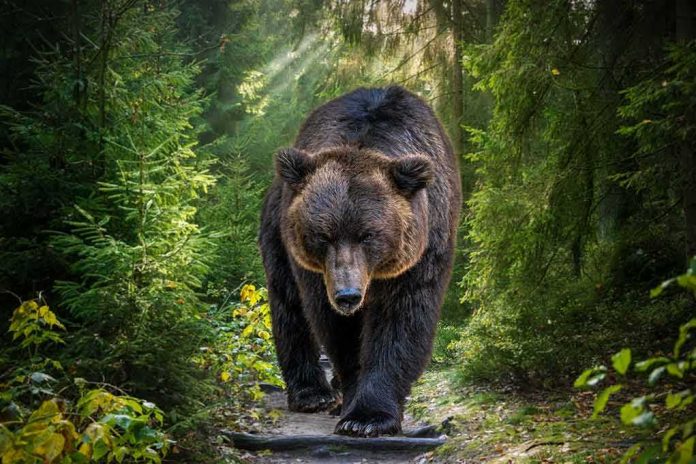
The moment two juvenile grizzlies thundered past a pair of hikers in Glacier National Park turned a routine walk into a split-second test of everything we say we know about “bear safety.”
Story Snapshot
- A viral clip shows two grizzlies charging down a Glacier National Park trail within just a few feet of hikers.
- Park history shows both successful defenses with bear spray and tragic fatalities in grizzly country.
- Officials frame most close calls as “surprise encounters,” while critics question whether hikers and policy really do enough.[1][2]
- The real issue is not fear of bears, but whether common-sense rules are being followed — and enforced — on the ground.[1]
What Actually Happened On That Glacier Trail
The video that rocketed around social media shows two young grizzly bears barreling straight down a narrow Glacier National Park trail, racing past a pair of hikers who hug the edge as the animals blast by within a few feet.[2] The woman filming later said the bears were about five feet away at their closest point.[2] No one was injured, no bear spray was deployed, and the entire encounter lasted only a few seconds before the animals disappeared down the path.[2]
National Park Service guidance for Glacier National Park is clear: if an animal is moving in your direction on a trail, you get out of its way and let it pass.[1] That is exactly what these hikers did. They stepped aside, did not run, and did not scream, which aligns with the park’s advice to avoid triggering a chase response or escalating defensive behavior.[1] By the book, this was a textbook “let the bear pass” moment that happened to be caught on camera.
Bear Safety Rules And How They Worked Here
Glacier’s official bear safety page stresses several pillars: hike in groups, make noise, avoid surprising bears, carry accessible bear spray, and never intentionally get close to a bear.[1] It also states that if a bear is moving toward you on a trail, you move away and keep the animal’s line of travel clear.[1] In the viral encounter, the bears clearly had a destination and treated the hikers like obstacles, not prey, sprinting past rather than turning to investigate or charge.[2][1]
Recent park history supports the idea that when people follow these rules and carry bear spray, outcomes tend to be far better. In 2025, two hikers near Lake Janet encountered a medium brown bear with two cubs that charged from the brush; one hiker was injured, but the partner deployed bear spray, and the bear immediately ran away. Park rangers and air rescue responded quickly, and the injured hiker remained stable as she was evacuated. That incident underscores that preparedness and quick action can turn a potentially fatal attack into survivable injuries.
When Grizzly Encounters Turn Deadly Instead Of Viral
Glacier’s record is not bloodless. In 2026, search teams found the body of a missing hiker on the park’s west side, with evidence that he was likely killed by a grizzly bear. Reports describe injuries and scene signs consistent with a surprise bear attack, and officials concluded a grizzly was the probable cause of death. The incident reignited questions about whether hikers are truly prepared for grizzly country or whether they underestimate how quickly a routine walk can turn lethal.
Decades of Glacier National Park incident reports show a mix of tragic patterns.[1] Some attacks stem from hikers leaving designated trails, approaching or photographing bears at close range, or flushing animals from cover, creating truly dangerous surprise encounters.[1][2] Other incidents involve careful hikers who did nothing obviously wrong and still ended up in a predator’s path.[1] Those contrasting cases fuel ongoing arguments between park officials who stress education and personal responsibility, and critics who say policy and messaging still leave too much to chance.
Surprise Encounter Or Human Error: Why Labels Matter
Glacier’s internal language matters more than most visitors realize. Incident records typically sort bear events into categories such as “surprise encounter,” “defensive behavior,” “provocation,” or “lingering/aggressive bear behavior.”[1] When a case is labeled a surprise encounter, the implication is that the hikers did not intentionally cause the conflict, which shapes both public reaction and whether the bear is later tracked or destroyed.[1][2] When the file suggests someone approached too closely or left the trail, the blame shifts sharply toward human error.
Two young grizzly bears gave a pair of hikers quite the fright when they came barreling down a trail at Glacier National Park in Montana.
“We’re going to die. We’re actually going to die. Holy heck!” Alyssa Olsen says in the footage. pic.twitter.com/Zpv54NKXTL
— ABC7 Eyewitness News (@ABC7) May 28, 2026
From a common-sense, conservative perspective, that distinction is crucial. Wildlife is not a theme park attraction; it is a risk you assume when you walk into big, wild country. The state’s job is to post clear rules and enforce them, not to bubble-wrap every trail. Glacier’s bear safety guidance is detailed and practical: stay on trail, make noise, keep 100 yards from bears, carry bear spray, do not leave food or trash accessible, and never intentionally close the distance to wildlife.[1] When people choose differently, responsibility should fall primarily on them.
Why This Viral Clip Should Change How You Hike
The Glacier trail video compresses the entire grizzly debate into a three-second blur. On the one hand, it validates park officials’ claim that most bears want nothing to do with us; given a clear path, they will blast right by rather than stop to attack.[1][2] On the other hand, it shows how razor-thin the margin is between a story you tell at dinner and a story a ranger writes in an incident file. Five feet is not a safety buffer; it is grace.
For anyone planning to visit Glacier or any grizzly country, the takeaway is not to stay home, but to treat the rules as survival tools, not suggestions. Hike with others. Make noise. Keep your distance. Carry bear spray where you can reach it, and know how to use it.[1] The system works best when individuals do their part. The hikers in that viral video did just enough right. The next pair on that same trail may not get such a forgiving test.
Sources:
[1] YouTube – Hikers dodge charging grizzly bears at Glacier National Park. See the …
[2] Web – NPS Incident Reports – Glacier National Park