

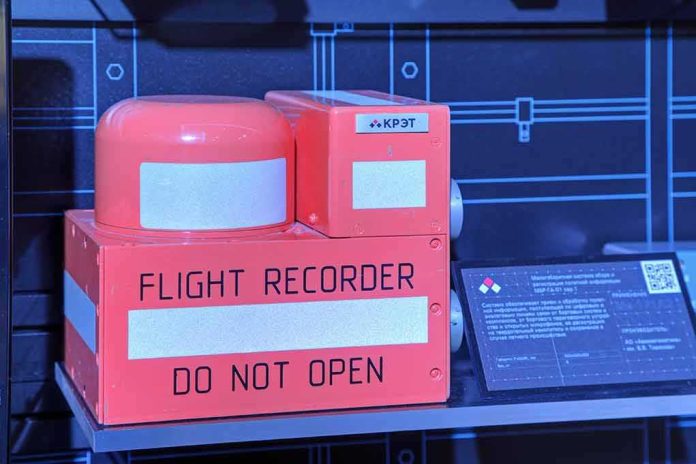
Federal investigators have pulled the cockpit voice recorder from the wreckage of a Learjet 60 that crashed near Greenacres, Florida, killing all nine people on board.
Quick Take
- The National Transportation Safety Board (NTSB) recovered the cockpit voice recorder at the crash site and confirmed it on its official investigation page.
- The device was found exactly where the plane first hit the ground, tying it directly to the accident aircraft.
- It is now being examined at the NTSB’s Vehicle Recorders Laboratory in Washington, D.C.
- Investigators have wrapped up on-site excavation work now that the recorder is in hand.
What Investigators Found At The Crash Site
The Learjet 60 went down on November 1 near South Military Trail, between Cresthaven Boulevard and 10th Avenue North, in Greenacres. All nine people aboard died. The NTSB says the cockpit voice recorder was located right at the site of initial impact, which links the device directly to the plane and the crash scene investigators have been combing through for days.
Finding the recorder matters because it is one of the clearest physical links back to the final moments in the cockpit. Aviation Week independently confirmed the recovery and reported the device has already been shipped to federal technicians for analysis, matching the NTSB’s own account of events.
Why The Device Now Heads To A Washington Lab
The recorder is being evaluated inside the NTSB’s Vehicle Recorders Laboratory in Washington, D.C. This is not a side office. It is the specialized facility where federal technicians use sound equipment and computers to pull data off damaged recorders recovered from crash sites. Recovering the recorder was also the final step on-site. The NTSB says excavation work at the impact location is now finished, meaning crews have moved past the physical search phase of the investigation.
Recovering a recorder and successfully reading it are two different things, and federal investigators have not yet said whether this one survived the crash intact. Reporting around the recovery has noted that officials have not confirmed whether the device was damaged or whether it holds usable recordings. That distinction matters because recorders sometimes come out of wreckage with scorched, cracked, or corrupted memory chips that take technicians weeks to even assess, let alone decode.
What Happens Once The Lab Gets To Work
Federal law actually blocks the NTSB from releasing the raw audio itself to the public. Instead, if the recording is usable, investigators can release a written transcript once the broader investigation file is opened. That protection exists to keep final cockpit conversations from becoming public spectacle while still letting investigators use the content to determine what happened. It is a sensible balance between transparency and respect for the families involved.
Past crashes show why patience matters here. In one earlier case, investigators could not recover any audio at all because the recorder’s data had simply been overwritten before the plane went down. In another, technicians achieved what is called a chip-level recovery, pulling data directly off the memory hardware when the recorder itself was too damaged to play back normally. Both outcomes are possible here, and neither has been announced yet.
The Broader Investigation Still Has Ground To Cover
A voice recorder is only one piece of what federal investigators need. Teams are also expected to examine recovered aircraft parts, including wings, engine components, and flight-deck hardware, and to line up any usable cockpit audio against air traffic control recordings, radar tracks, and weather data from that day. That cross-checking process is standard practice and often takes investigators months before a cause is formally assigned.
For families of the nine victims and for the Greenacres community that watched the crash site get worked for days, the recovery is a real step forward, not a finish line. The NTSB has confirmed what it found and where. What that recorder actually captured, and whether it survived the crash well enough to be heard at all, is the next chapter investigators still have to write.
The National Transportation Safety Board (NTSB) announced on Monday that it has recovered the cockpit voice recorder of the Learjet 60 that crashed last week near Greenacres, Florida, killing all nine people on board. https://t.co/oF1k8Jh5Gb pic.twitter.com/d4UN4nbQiC
— Yahoo News (@YahooNews) November 10, 2026
The agency has not given a timeline for when lab results or a preliminary report might be released, and officials have not detailed the recorder’s condition beyond confirming it was recovered and sent for evaluation. Until that technical work is done, the recovery itself remains the most concrete development in a case that nine families are waiting to understand.