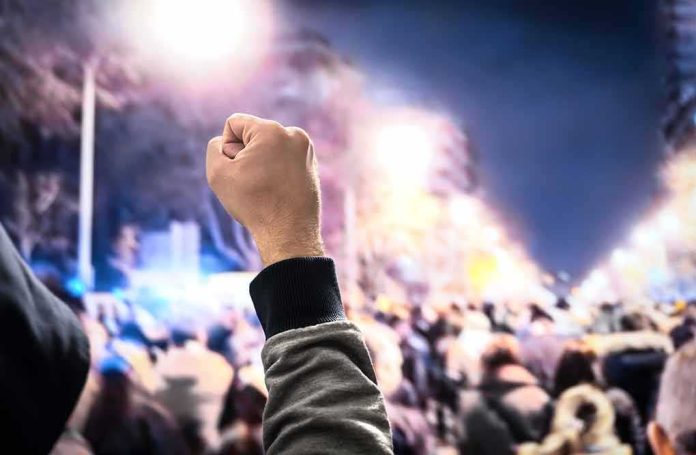
The photo that sold a “HUGE crowd” for James Talarico in deep-red Lubbock does not match the event it was tied to—and the mismatch is the tell.
Story Snapshot
- Talarico’s official campaign account amplified a “HUGE crowd” claim for a Lubbock rally.
- Independent reporting confirms a real, large Lubbock turnout near the Watson Building.
- The dispute centers on whether the posted crowd image actually depicted that Lubbock rally.
- Misused crowd photos are a common tactic that skews public perception of momentum.
What the campaign posted, and what the record shows
The campaign’s social message boasted a “HUGE crowd” for James Talarico in Lubbock, a county long seen as safe for Republicans. The Irish Times noted the same “HUGE crowd” claim while describing a real line around the block and a crowd near 1,500 inside the Watson Building. That reporting shows Lubbock enthusiasm existed. The open question is whether the circulated image matched that specific rally scene, or leaned on a stronger visual from elsewhere to juice the vibe.
Coverage from national and local outlets painted a fuller West Texas picture. The Atlantic observed packed energy at rival events the same week, underscoring how hot the primary fight ran across the region. A Texas Tech track star also posted video of Talarico speaking to a packed “Take Back Texas” crowd in Lubbock, which supports the claim that interest there was authentic—even if one amplified image did not match the exact moment touted.
Why the image-details fight matters more than you think
Campaigns know images travel faster than context. One dramatic photo can suggest a tipping point, even when the actual event was only large, not historic. This is why crowd-size imagery becomes a proxy fight over legitimacy. Voters absorb the picture first and the correction never fully catches up. Fact-checkers have tracked this pattern for years: real events paired with photos that are cropped, miscaptioned, recycled, or compared across apples and oranges to inflate momentum.
In prior cycles, both parties got burned by this. Analysts debunked claims of artificial intelligence crowd shots at a Kamala Harris rally by confirming the original images with wire-service photos and forensic analysis. Other times, a crowd image proved real but misused in side-by-side comparisons that misled on scale or timing. The lesson repeats: the crowd may be real; the caption sells a story the pixels do not actually prove.
The Lubbock event was big; the caption turned it into a weapon
The Irish Times described the Lubbock scene in detail: a midday line around the Watson Building, fans overhead, and a lively audience estimated around 1,500. That alone signals reach into a red stronghold. The Atlantic’s account of a jammed rally for a competing Democrat the same stretch suggests West Texas interest was broadly high. Those facts cut two ways: they show legit energy for Talarico, and they show why the campaign would feel safe pushing a bolder visual to lock in a narrative of a breakthrough.
Common sense and conservative values favor plain dealing. Sell the real number, not the sizzle reel. If a campaign uses a mismatched image to oversell a moment, it treats voters like marks. The behavior feeds cynicism that politics is all theater. When a rally already drew a strong crowd, there is no excuse to borrow a looser photo and slap on a tighter caption. Tell the truth, and let adults judge the turnout as it was.
How to size up the next viral rally photo in five seconds
Check the venue against known shots from reputable outlets or wire services. Look for unique markers: signage, ceiling shape, balcony rails, exit signs. Compare clothing layers to the local weather that day. Scan for flags, stage builds, and camera platforms that match published coverage. Then read the caption with fresh eyes: date, city, event name. If those do not line up with independent reports from that place and time, treat the post as messaging, not evidence.
🇺🇸 Trump told a rally crowd tonight that James Talarico, the Democrat trying to take a Texas Senate seat, is a vegan who eats meat and then throws it up
He called him a freako, mangled the word vegan, and said vegans do not do well in Texas.
This started with an old clip where…
— Mario Nawfal (@MarioNawfal) October 1, 2026
Campaigns will keep testing the edge because it works. But voters can short-circuit the trick. Demand one photo, one event, one caption that matches reality. Lubbock shows why. The crowd was real. The enthusiasm was real. The problem began when a single image promised more than the moment delivered. That is not savvy; that is spin. And spin is a tax on trust that Texans, of all people, should refuse to pay.
Sources:
yahoo.com, theatlantic.com, prattontexas.com, baylorlariat.com, washingtonexaminer.com