One man’s carry-on bag at Sacramento International Airport may become a case study in how fear, evidence, and intent collide in modern American justice.
Story Snapshot
- Federal prosecutors say a Sacramento man tried to board a flight with a working homemade explosive device in his backpack.
- Transportation Security Administration screeners allegedly found not just an M-type explosive, but blades, zip ties, and five cell phones.[1][2][3]
- The government’s version of events is detailed and vivid; the defense’s version, so far, is mostly silence and the presumption of innocence.[1][2][3]
- The case exposes how quickly a narrative hardens when law enforcement speaks first and loudest, long before a trial ever happens.
Airport bag, late flight, and a device that tested “viable”
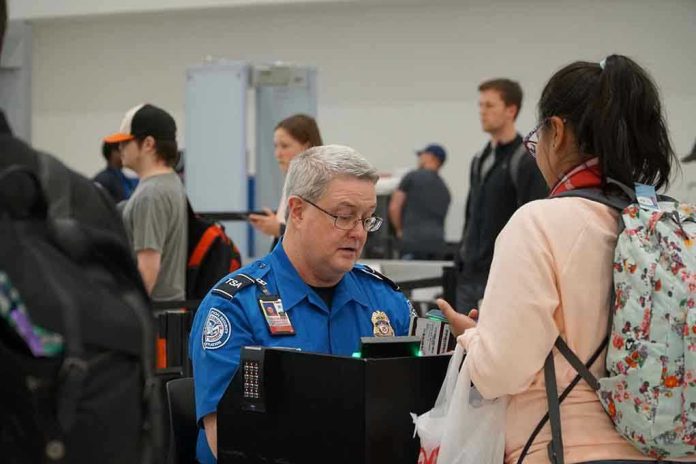
Federal prosecutors say forty-nine-year-old Kimani Osayande Jones, also known as Kimani Osayande Jackson, showed up at Sacramento International Airport on the night of May 30 to catch an American Airlines flight to Charlotte.[2][3] Transportation Security Administration screeners allegedly found a brown cylindrical device about two and a half inches long with a green fuse in his carry-on backpack, along with a butane torch lighter.[1][2] A criminal complaint claims later testing found the fuse and powder “viable and energetic.”[2][3]
The Department of Justice says bomb technicians from the Federal Bureau of Investigation and the Sacramento County Sheriff’s Office removed the device, placed it in a suppression container, and took it for testing.[2][3] According to the complaint, an FBI bomb technician concluded that if the device detonated on an aircraft above ten thousand feet, it could damage a window and potentially cause loss of cabin pressure.[2] Prosecutors then charged Jones with unlawfully possessing explosive material in an airport, a felony that carries up to five years in prison and a quarter-million-dollar fine if convicted.[2][3]
The ominous bundle: blades, zip ties, and five phones
Local reporting says the device was not the only thing hidden in the bag.[1] The Sacramento Bee and other outlets, summarizing the federal complaint, describe a knife, additional blades, scissors or scissor blades, an aerosol can, zip ties, and five cell phones alongside the explosive.[1][2][3] Television coverage highlighted that the device was allegedly an “M-type” explosive, the kind of small improvised firework-style device that can still deliver serious damage in a confined space like an aircraft cabin.[1][3]
One detail grabs immediate attention: five phones and a timer, with one report describing a fifteen-minute countdown and an ominous message on a screen.[2] That combination—multiple phones, a countdown, a working explosive, blades, and restraints—naturally feeds into the worst-case mental picture for any traveler. Federal agents live inside those possibilities; ordinary citizens just see the headline and mentally convict. From a conservative common-sense perspective, that cluster of items demands serious scrutiny and tough questions.
What prosecutors say versus what we do not yet know
The public record so far runs almost entirely on the prosecution’s fuel. The Department of Justice issued a detailed press release. Local and national media repeated the allegations with added color about the scarf over Jones’s face and blue latex gloves that made Transportation Security Administration officers suspicious even before the bag went through the scanner.[2][3] Those details reinforce a narrative of intent: here is a man trying, at night, to slip a working explosive and suspicious tools past airport security.
The defense side, at least in public, is noticeably thin. There is no defense press conference, no counter-expert, no sworn affidavit challenging whether the powder was really as dangerous as claimed, no alternate explanation for why those items were in the backpack.[1][2] Legally, Jones is presumed innocent. Practically, when only the government speaks, the government’s story becomes the story. That imbalance is not new, but it is powerful, especially when the word “airport” sits next to the word “explosive.”
Security theater, real threats, and the presumption of innocence
Airport explosive cases often start the same way: a dramatic interdiction, a stern press release, and breathless headlines, followed by months of quiet procedural grinding in federal court.[3] Most federal cases never reach trial; they end in plea deals that the public rarely reads. That pattern means the first narrative is usually the last one most citizens ever hear. With that in mind, thoughtful conservatives should hold two ideas at once: take the threat seriously, and demand the government prove every element, especially intent.
From a common-sense, law-and-order perspective, the state must aggressively stop anyone who appears to bring explosives and weapons onto a plane. At the same time, a system that can take away a citizen’s liberty has a duty to withstand scrutiny. Independent explosives analysis, full disclosure of Transportation Security Administration footage, and careful digital forensics on those phones would either confirm the prosecutors’ chilling picture or expose overreach. Justice is not a feeling; it is a tested conclusion. This case is barely at the starting line.
Sources:
[1] Web – Man nabbed with bomb in California airport
[2] Web – Sacramento man facing explosives charge after SMF arrest
[3] Web – Sacramento man found with explosive during airport security check …