

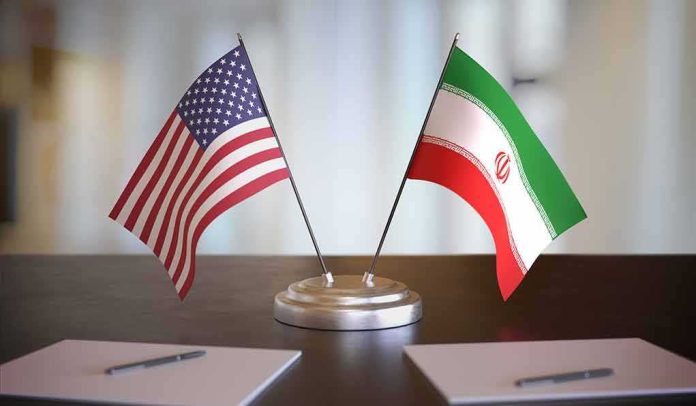
A tentative 60-day ceasefire framework between the United States and Iran is sitting on President Trump’s desk right now, and what happens next could reshape the Middle East’s nuclear future — or blow the whole thing apart.
Quick Take
- U.S. and Iranian negotiators have reportedly agreed on a framework to extend their ceasefire for 60 days, pending President Trump’s final approval.
- The deal would reopen the Strait of Hormuz to commercial shipping and launch formal negotiations over Iran’s nuclear program.
- Iran insists on verified, reciprocal steps before making deeper commitments, while the U.S. demands Iran surrender its enriched uranium stockpile.
- The framework remains unfinished, with unnamed sources on both sides, no published treaty text, and active military incidents still threatening the pause.
A Deal That Exists Mostly on Paper — For Now
Negotiators from both governments have reportedly hammered out a memorandum of understanding framework that would extend the current ceasefire by 60 days and open formal talks on Iran’s nuclear program. Secretary of State Marco Rubio described the state of play as having “strong alignment and agreement on what a preliminary draft should look like,” while acknowledging that disputes over specific wording remain unresolved. [1] That is diplomatic language for: we are close, but not there yet.
The framework’s most concrete provision involves the Strait of Hormuz, the narrow waterway through which roughly 20 percent of the world’s traded oil passes. Under the reported terms, commercial shipping would be restored to pre-war levels within 30 days, with military vessels excluded from the arrangement. [1] For global energy markets already rattled by conflict, that single provision carries enormous economic weight. Whether both sides are reading the same draft on that point is, unfortunately, still an open question.
What the U.S. Is Demanding and What Iran Is Protecting
The Trump administration’s position is unambiguous on one point. A White House spokesperson stated that Trump “will only make a good deal for the American people which must ensure that Iran can never have a nuclear weapon.” [1] A senior administration official went further, saying the deal requires Iran to relinquish its enriched uranium stockpile entirely — with Trump reportedly saying it “would be destroyed.” That is not a negotiating footnote. That is a fundamental demand that Tehran has every incentive to resist, delay, or redefine.
Iran’s posture, filtered through sources close to the Tehran negotiating team, is that no implementation steps will occur without tangible verification of reciprocal U.S. actions. [1] That is a rational position for a government that has watched sanctions return and agreements dissolve before. Iran is also pushing for any finalized deal to be formalized as a binding United Nations Security Council resolution — a legal mechanism that would constrain unilateral American reinterpretation down the road. [1] Whether that demand survives contact with Washington’s political reality is another matter entirely.
Pakistan’s Role and the Fragile Ground Beneath the Ceasefire
The initial ceasefire, struck in April 2026, was mediated by Pakistan, with talks channeled through Islamabad before being finalized there. [1] Pakistan’s continued role as a back-channel facilitator gives the framework a structural legitimacy it would otherwise lack, given the absence of any direct U.S.-Iran diplomatic relationship. Mediators, according to multiple reports, believe the two sides are genuinely nearing agreement on the 60-day extension. [3] But believing you are close and actually closing are two different things in Middle East diplomacy.
🚨: US and Iran Reach Tentative Deal to Extend Ceasefire for 60 Days
US and Iranian negotiators have agreed on a framework to extend their fragile ceasefire by 60 days and begin talks on Iran’s nuclear programme, according to US sources.
The deal has not yet been approved by… https://t.co/XE3dzsOuK6
— The Cable® (@TheCableHaux) May 28, 2026
The ceasefire itself is showing stress fractures. Iran’s foreign minister declared that U.S. military strikes during the pause were ceasefire violations that “will not go unanswered,” while U.S. military officials described the same strikes as self-defense. [1] Separately, the ceasefire nearly collapsed after Iran reported shooting at U.S. drones and a fighter jet, with American forces responding. [5] Defense Secretary Pete Hegseth argued before Senate lawmakers that the ceasefire effectively pauses the 60-day operational deadline, but that argument requires both sides to agree on what the ceasefire actually covers. [2] Right now, they clearly do not.
Netanyahu, Spoilers, and the Deal’s Biggest External Threat
Israeli Prime Minister Benjamin Netanyahu has been openly opposed to the framework and reportedly preferred preemptive military strikes against Iran’s nuclear infrastructure. That opposition is not a minor diplomatic inconvenience. Israel has both the motive and the demonstrated capability to act unilaterally in ways that would force both Washington and Tehran to abandon any negotiated pause. An Israeli strike during a 60-day ceasefire window would not just complicate the talks — it would almost certainly end them. The administration has not publicly addressed how it intends to manage that specific risk.
What This Deal Is Really About
Strip away the diplomatic language and what remains is this: the United States wants Iran’s nuclear program permanently constrained, and Iran wants sanctions relief, legal guarantees, and survival as a regional power. Neither side can say that plainly in public, so both sides talk about ceasefire extensions and uranium stockpiles. The 60-day window, if Trump approves it, is not a peace deal. It is a structured pause that buys time for a harder conversation neither government has fully prepared its domestic audience to accept. Whether that conversation ever happens depends on decisions being made right now in Washington. [4]
Sources:
[1] Web – BREAKING: US, Iran reach tentative 60-day ceasefire deal, to negotiate …
[2] Web – 2026 Iran war ceasefire – Wikipedia
[3] YouTube – Iran war: Hegseth argues ceasefire pauses 60-day deadline
[4] Web – Mediators believe Iran and US nearing 60 day extension on …
[5] Web – US, Iran close to agreeing a 60-day ceasefire extention