
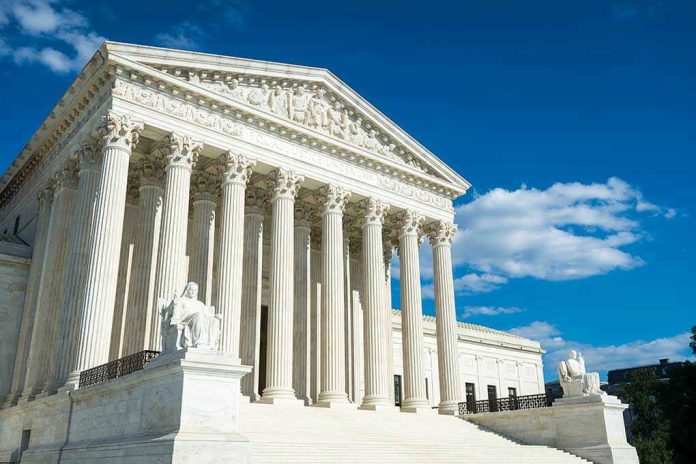
The most powerful sports league in America just got told “no” by the one institution it cannot overrule: the Supreme Court.
Story Snapshot
- The Supreme Court refused to rescue the National Football League’s attempt to force Brian Flores’ racial discrimination case into league-controlled arbitration.
- Flores’ class action lawsuit now marches forward in open federal court, where discovery, witnesses, and documents happen in public, not behind closed doors.
- The case attacks not just one bad hiring decision, but the National Football League’s entire system of “Rooney Rule” minority interviews and coaching pipelines.
- The outcome could reshape how powerful employers handle discrimination claims and kill the era of the boss secretly serving as judge and jury.
The Supreme Court’s quiet but brutal message to the NFL
The Supreme Court declined to hear the National Football League’s appeal after the league lost its fight to drag Brian Flores’ discrimination lawsuit into its own arbitration system, leaving in place lower court rulings that the case belongs in open court.[1][2][3] A federal judge had already called the league’s setup a “fatal flaw” for discrimination cases because the commissioner, who runs the league, ultimately controls the arbitration forum.[1][3] When the Supreme Court shrugs at your appeal, it is not an endorsement; it is a refusal to save you.
What this means, in plain terms, is that the National Football League does not get to keep this fight locked in the back room of its Park Avenue offices. Flores’ claims, along with those of other Black coaches who joined the suit, will be tested under federal civil rights law before an independent judge and, potentially, a jury of ordinary citizens.[1][2][3] For anyone who values due process and basic American fairness, that is exactly where accusations of systemic racial discrimination belong.
What Brian Flores is actually alleging about the NFL
Brian Flores, a Black coach who led the Miami Dolphins and then was fired despite back-to-back winning seasons, filed a class action complaint in 2022 accusing the National Football League and multiple teams of race discrimination in hiring and promotion of coaches and front-office staff.[3][4][6] He claims that Black and minority coaches are held to higher standards, passed over for less qualified white candidates, and often used as “window dressing” to satisfy diversity rules without any real shot at the job.[3][4][6]
The complaint zeroes in on the Rooney Rule, which requires teams to interview underrepresented minority candidates for head coach and certain leadership roles.[4][6] Flores alleges that teams turned that requirement into a sham: going through the motions of interviews after privately deciding to hire a white candidate.[4][6] He cites the New York Giants’ 2022 head coach search, where texts from Bill Belichick allegedly showed the Giants had chosen Brian Daboll before Flores even interviewed, and his 2019 Denver Broncos interview where top executives allegedly arrived late and disheveled, signaling the decision had already been made.[4][6]
Why the arbitration fight matters more than most people realize
The league tried to force Flores and the other plaintiffs into private arbitration under contracts that give the commissioner sweeping control over who hears disputes and how they are handled.[1][3] In discrimination law, that arrangement looks like the boss choosing the judge in his own case. A federal district judge rejected that approach for core claims, finding that the commissioner’s dual role as league leader and final word in arbitration undermined the basic requirement of a neutral decision-maker.[1][3]
The United States Court of Appeals for the Second Circuit later affirmed the denial of arbitration for key claims against teams like the New York Giants, Denver Broncos, and Houston Texans, keeping those disputes in court.[3] The Supreme Court’s refusal to intervene leaves that structure intact. From a common-sense conservative perspective, this restores a healthier balance: employment disputes of public importance get aired in real courts, not in what one analyst bluntly called the league’s “secret rigged kangaroo court.”[7] That does not mean Flores is right on the facts; it means he gets a fairer arena.
How strong are Flores’ claims under the law?
Flores’ lawsuit rests on federal civil rights law, particularly Section 1981, and state anti-discrimination statutes, claiming both intentional discrimination (“disparate treatment”) and structural practices that disproportionately harm Black candidates (“disparate impact”).[3][5][6] His filing leans on specific episodes, like the Giants and Broncos interviews, and broader patterns in league hiring data. Harvard Law School’s analysis frames his case as an attack on the league’s “standard operating procedure,” not just a few rogue decisions.[3][4]
The Supreme Court turned away an appeal by the NFL stemming from coach Brian Flores' racial discrimination suit, allowing his case to proceed in federal court. https://t.co/XeErrqkQsN
— CBS News (@CBSNews) May 26, 2026
Legal scholars are split on how strong some of those claims are. One detailed law review article questions whether “sham interviews” alone, even if proved, automatically amount to actionable discrimination, especially when the rule only requires a minority interview, not a fair shot at the job.[5] That critique echoes a conservative concern: not every ugly or unfair practice is illegal, and courts should resist turning hurt feelings into federal cases. Still, the article concedes that proving unequal treatment between similarly qualified white and Black candidates would change the analysis.[5]
The bigger stakes: power, transparency, and future hiring battles
Flores’ case now moves into discovery, where lawyers can demand internal emails, text messages, interview notes, and hiring statistics from the league and its teams.[1][2][3] That phase is where carefully crafted public-relations narratives often collide with the blunt reality of how decisions were actually made. If patterns show a consistent funneling of Black coaches into dead-end interviews and white candidates into the real consideration track, the league’s defense could weaken quickly.[3][4][6]
For American workers outside football, the stakes are larger than who calls plays on Sunday. Corporate America has increasingly relied on mandatory arbitration and internal procedures to keep discrimination and harassment claims out of open court. The National Football League’s loss here sends a signal: when the decision-maker is too close to the money, judges are more willing to step in. That aligns with a healthy conservative skepticism of concentrated power, whether it sits in Washington or in a multibillion-dollar entertainment cartel.
Sources:
[1] Web – Brian Flores’ racial discrimination lawsuit against NFL can proceed …
[2] Web – Ruling says Brian Flores lawsuit vs. NFL, teams can go to court – ESPN
[3] Web – Case: Flores v. The National Football League
[4] Web – Brian Flores vs. the NFL – Harvard Law School
[5] Web – [PDF] Brian Flores’s Employment Discrimination Lawsuit Against the NFL
[6] Web – [PDF] Case 1:22-cv-00871 Document 1 Filed 02/01/22 Page 1 of 58
[7] YouTube – Analyzing latest in Brian Flores’ lawsuit against the NFL