

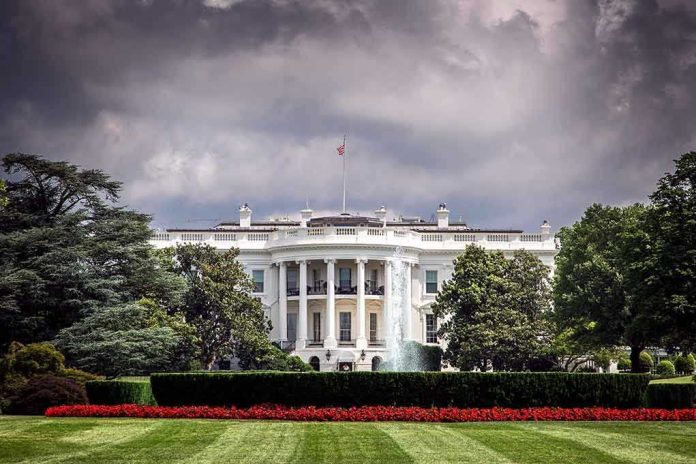
Federal health officials detected a statistically significant stroke signal in elderly Americans after receiving Pfizer’s COVID-19 bivalent booster, yet the Biden White House edited agency warnings to minimize public concern while continuing secret internal investigations for nearly three years.
Story Snapshot
- November 2022 vaccine safety systems flagged elevated ischemic stroke risk in adults 65+ following Pfizer bivalent booster shots
- White House officials altered CDC and FDA messaging in January 2023, changing “moderately elevated” risk to “slightly elevated” without public warnings
- Internal “Stroke Project” continued investigating the signal through September 2025 while boosting vaccination campaigns
- Senator Ron Johnson released 2,000 pages of HHS records in March 2026 revealing the editing and delayed disclosure
- No confirmed causal link established, but the public remained uninformed about ongoing safety investigations
When Safety Signals Become Political Liability
U.S. vaccine safety surveillance systems operate on empirical Bayesian methods, sophisticated statistical tools designed to catch rare adverse events buried in massive datasets. These systems performed exactly as intended in November 2022 when they detected an unusual pattern: adults over 65 receiving Pfizer’s bivalent COVID booster showed statistically significant rates of ischemic strokes within specific timeframes. The signal demanded investigation. What happened next reveals how public health bureaucracy navigates the treacherous intersection of scientific uncertainty and political messaging when billions of dollars and administrative credibility hang in the balance.
The Language of Risk Management
January 2023 drafts prepared by CDC and FDA scientists described the stroke signal as “moderately elevated.” White House officials intervened. The final public statement downgraded the risk to “slightly elevated” and assured Americans no changes to vaccination practices were necessary. This wasn’t mere wordsmithing. The administration faced competing pressures: a winter COVID surge, abysmal booster uptake rates among vulnerable elderly populations, and mounting Republican criticism of vaccine mandates. Health and Human Services leadership chose promotion over precaution, launching campaigns to increase booster coverage while keeping stroke investigations internal and confidential.
The Three-Year Secret Investigation
Behind closed doors, federal scientists pursued what internal documents call the “Stroke Project.” From January 2023 through September 2025, researchers analyzed the signal’s validity, examining whether the statistical association reflected genuine biological risk or artifact from data mining across millions of vaccination records. The challenge with empirical Bayesian surveillance: false positives emerge frequently when algorithms scan for hundreds of potential adverse events simultaneously. Validation requires painstaking epidemiological work comparing vaccinated and unvaccinated cohorts while controlling for confounding variables like underlying cardiovascular disease prevalence in elderly populations. Legitimate scientific caution, perhaps, but the public funding this research received no updates, no interim findings, no transparency about ongoing safety questions regarding shots actively promoted by the same government.
Senator Johnson’s Paper Trail
Wisconsin Republican Ron Johnson chairs the Senate Permanent Subcommittee on Investigations, a perch providing subpoena power over federal agencies. Johnson has pursued COVID vaccine safety questions since 2021, drawing criticism from medical establishments as vaccine-skeptic grandstanding and praise from conservative constituencies demanding accountability. His March 2026 letter to HHS Secretary Robert F. Kennedy Jr. accompanied a document dump: nearly 2,000 pages of internal HHS records obtained through subpoena. The records confirm the November 2022 signal detection, document White House editorial intervention in agency communications, reveal the multi-year Stroke Project’s existence, and expose the absence of any public warning despite active investigation. Johnson characterized this as “failure to warn public about adverse events” and accused officials of “unsupported devotion to a harmful vaccine.”
The Transparency Problem in Public Health
No established causal connection links Pfizer’s bivalent booster to ischemic strokes. Statistical signals require validation because correlation doesn’t equal causation, particularly when analyzing data from populations already at elevated baseline risk for the adverse event in question. Adults over 65 suffer strokes at higher rates regardless of vaccination status. Distinguishing vaccine-related risk from background rates demands rigorous methodology and time. Defenders of federal handling argue agencies followed standard protocol: detect signal, investigate thoroughly before alarming the public with potentially false information that fuels vaccine hesitancy.
This defense collapses under the weight of what wasn’t done. Transparent disclosure of ongoing investigation, interim updates on findings, and acknowledgment of uncertainty would have maintained public trust while avoiding premature conclusions. Instead, officials made a calculated political choice: maximize booster uptake by minimizing perceived risk, even as internal scientists worked to determine if that risk was real. The editing of scientific agency language by White House political staff crystallizes the problem. When bureaucrats prioritize message control over information sharing, they treat citizens as subjects to be managed rather than stakeholders entitled to participate in risk-benefit decisions about their own health.
The stroke signal investigation reportedly concluded by September 2025 without establishing causation or prompting vaccination practice changes. HHS hasn’t publicly released final findings. Johnson’s probe continues, demanding complete records with minimal redactions. The episode extends beyond COVID vaccines into fundamental questions about administrative state accountability. Federal health agencies command enormous authority to shape medical practice and public behavior through recommendations carrying quasi-regulatory force. That authority rests on presumed scientific integrity and transparency. When political considerations drive information management, the entire edifice of public health credibility erodes. Americans already skeptical of institutional medicine find confirmation. Those defending vaccination programs lose moral authority to dismiss safety concerns as misinformation. The real cover-up wasn’t hiding confirmed stroke risk; it was hiding uncertainty itself, treating adult citizens like children unable to handle complexity or ambiguity in medical decision-making.
Sources:
Biden White House edited messaging on strokes after COVID-19 vaccination
Claim circulates that emails reveal the White House hid COVID-19 vaccine risks
PSI Majority Staff Interim Report: Failure to Warn
Doctors testify vaccine side effects and Biden admin communication mishaps under scrutiny