

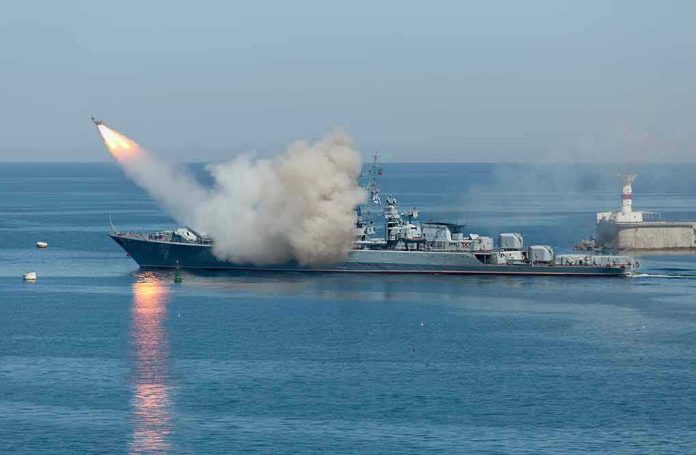
Declassified footage captures U.S. forces obliterating over 50 Iranian warships in seconds, exposing the regime’s hidden naval ambitions and America’s unyielding resolve—but at what cost to global readiness?
Story Snapshot
- U.S. Operation Epic Fury destroys more than 50 Iranian vessels, missile sites, and production facilities, crippling Tehran’s power projection.
- Strikes follow Iran’s recovery attempts after 2025’s Operation Midnight Hammer, neutralizing threats to U.S. homeland and allies.
- White House confirms precision hits on underground bunkers, with intelligence assessing Iran as largely degraded yet proxy-active.
- Campaign strains 40% of U.S. carriers and half of B-1 bombers, revealing munitions shortages and risks to Pacific deterrence.
Operation Epic Fury Unleashes Precision Devastation
U.S. forces launched Operation Epic Fury in early 2026 to preempt Iran’s military rebuilding after June 2025’s Operation Midnight Hammer. B-2 stealth bombers and carrier-based aircraft targeted missile production sites, underground facilities, and over 50 naval vessels. Declassified footage shows missiles slamming into Iranian ships, turning fleets into infernos. This campaign erased launch capabilities and stockpiles, delivering a strategic gut punch to Tehran’s conventional forces.
White House statements detail strikes on deeply buried missile silos, confirming destruction of production lines essential for UAVs and ballistic threats. Iran’s regime survives but weakened, its proxies still harassing U.S. positions in the Middle East. Common sense dictates this preemption saved lives by dismantling imminent dangers, aligning with conservative principles of strength over appeasement.
Iran’s Buildup Ignites U.S. Response
Iran amassed missiles, drones, and proxy networks threatening U.S. forces and Israel since the early 2020s. Prior clashes depleted 25% of America’s THAAD interceptors by late 2025. Tehran exploited the lull, racing to restore capabilities post-Midnight Hammer. U.S. intelligence tracked these moves, prompting Epic Fury to hit vessels in the Persian Gulf and facilities inland.
DoD deployed USS George H.W. Bush and destroyers alongside B-1 bombers from UK bases. Israel hosted THAAD batteries, bolstering the allied shield. Iran’s asymmetric tactics—proxy attacks in Iraq and Syria—persisted, but direct naval power projection crumbled under American firepower.
Asset Deployments Strain American Might
By March 18, 2026, Atlantic Council data showed 40% of U.S. carriers committed, 26% of destroyers, 50% of B-1s, and 26% of B-2s. E-3 AWACS at 66-75% deployment and 33% of tankers supported relentless sorties. THAAD systems covered 29-43% of needs, with carriers like USS Nimitz extending tours.
Munitions burned at alarming rates—$5.6 billion in two days—exposing pre-war hollowing of Patriot and Tomahawk stocks. Defense industry leaders met at the White House in early March to ramp production, limited to 96 THAAD units yearly. Rare earth dependencies and 27% destroyer maintenance cycles amplified vulnerabilities.
Strategic Gains Versus Hidden Risks
Short-term, Epic Fury halts Iranian threats, protecting allies and shipping lanes. Long-term, Tehran could rebuild over years if the regime endures, per DNI assessments. U.S. redeployments from Pacific and Europe weaken deterrence against China and Russia. Proxy escalations loom, testing American endurance.
Expert analyses from think tanks praise degradation of Iran’s missiles but warn of industrial base flaws. Prospect.org highlights a trillion-dollar force short on bombs, echoing Trump administration pushes for surges. Facts support optimism: U.S. dominance prevailed, but common sense demands fixing supply chains to avoid overstretch.
Intelligence reports forecast proxy persistence despite conventional losses. Ongoing strikes await full assessments, with no major contradictions in official tallies. This operation underscores resolve, yet reveals the price of multi-theater commitments.
Sources:
House Testimony on Iran Operations
Atlantic Council: Tracking U.S. Military Assets in the Iran War
DNI Annual Threat Assessment 2026
IranWire: White House Says US Destroyed Over 50 Iranian Military Vessels
Prospect: Iran War Exposes U.S. Military Supply Chain Issues