
New Mexico just became the first state to ban armed federal agents from polling locations, raising serious constitutional questions about who actually controls elections in America—and whether states are preparing to obstruct legitimate federal oversight.
Story Snapshot
- Governor Michelle Lujan Grisham signed SB 264 into law on March 9, 2026, prohibiting armed federal agents and military personnel at polling places
- The law imposes civil penalties up to $50,000 per violation and allows voters and election workers to sue for intimidation
- Democrats passed the measure along strict party lines, claiming to protect voters from federal “harassment” despite no evidence of such threats
- Seven other Democratic-controlled states have introduced similar legislation, signaling a coordinated effort to block federal election security measures
Democratic Lawmakers Block Federal Election Oversight
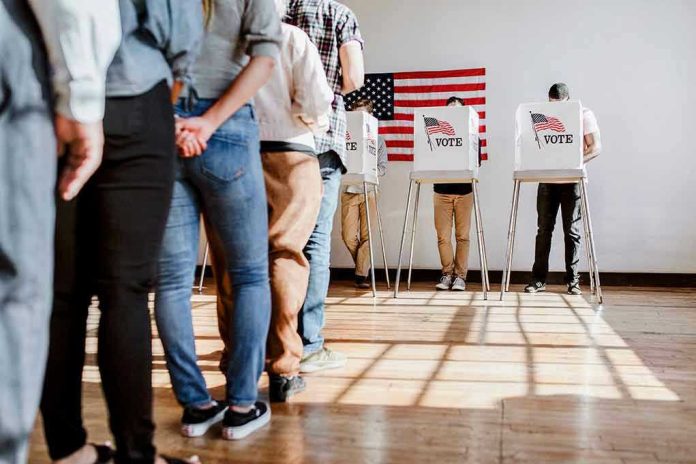
New Mexico’s Democratic legislature pushed through Senate Bill 264 with zero Republican support, passing the Senate 26-16 on February 15 and the House 41-26 on February 17. Governor Michelle Lujan Grisham signed the measure into law on March 9, 2026. The legislation prohibits armed federal agents, military troops, or any personnel in U.S. civil, military, or naval service from being deployed to polling places, ballot drop boxes, or within 50 feet of monitored ballot boxes. This sweeping ban takes effect during early voting periods and applies throughout Election Day.
House Majority Leader Reena Szczepanski, the bill’s sponsor, justified the measure by claiming it protects against federal attempts to “nationalize elections” and infringe on state rights. Yet Senate Minority Leader William Sharer pointed out the obvious: there’s no realistic scenario where a president would attempt to seize elections by force. This law appears to be a solution in search of a problem, motivated more by partisan distrust of federal authority than any genuine threat to voters.
Constitutional Concerns and Federal Authority
The legislation directly challenges the balance of power between state and federal government. While Article I, Section 4 of the Constitution grants states primary authority to administer elections, federal law already restricts military involvement at polling places through existing statutes rooted in the Posse Comitatus Act. What makes SB 264 different—and constitutionally questionable—is its attempt to preempt federal agents entirely, including those who might be legitimately investigating election fraud or ensuring compliance with federal voting rights laws. Legal experts have noted potential Supremacy Clause conflicts, where federal law may override state restrictions on federal officers performing their lawful duties.
The law’s $50,000 civil penalties and enforcement mechanism allowing voters, prosecutors, and election workers to sue create a chilling effect on any federal presence near voting locations. This raises troubling questions about whether states can effectively nullify federal law enforcement authority within their borders. If New Mexico can ban federal immigration agents or FBI personnel from polling sites, what prevents other states from blocking federal officers from investigating actual election crimes or protecting constitutional voting rights? The measure may ultimately require Supreme Court intervention to resolve these fundamental questions of federalism.
Nationwide Democratic Strategy Emerges
New Mexico’s law isn’t an isolated incident but part of a coordinated Democratic strategy across multiple states. California, Illinois, Virginia, Washington, and Connecticut have all proposed similar bans on federal immigration enforcement or armed agents near polling locations. Georgia Democrats introduced measures to block National Guard involvement, while Kansas lawmakers in a divided government mirrored the immigration enforcement restrictions. This pattern reveals a deliberate effort by Democratic-controlled states to insulate their election processes from federal scrutiny, particularly regarding immigration status verification—a core concern for conservatives who support measures like the SAVE Act to ensure only citizens vote.
The partisan divide couldn’t be clearer. While Democrats frame these laws as protecting voters from intimidation, they’re simultaneously blocking the very federal agents who could verify voter eligibility and investigate fraud. Interestingly, Arizona Republicans proposed requiring federal immigration officers at polls to deter illegal voting, though that measure was later dropped amid opposition from groups claiming voter suppression. The contrast illustrates fundamentally different visions: conservatives seeking to ensure election integrity through proper verification, progressives prioritizing unrestricted access even at the cost of potential fraud vulnerabilities. For Americans who watched the chaos of recent election cycles, New Mexico’s law looks less like voter protection and more like obstruction of legitimate federal oversight at a time when election integrity remains a paramount concern.
Sources:
New Mexico enacts law prohibiting the deployment of troops to polling places – Ballotpedia News