
A crowd can chant “abolish the police” at full volume and still depend on a police line to keep the night from turning ugly.
Story Snapshot
- March 28, 2026 “No Kings” protests spread nationwide, with major flashpoints near federal facilities.
- Video captured protesters chanting anti-police slogans while officers escorted and protected them.
- Los Angeles saw dispersal orders, a tactical alert, and tear gas after objects were thrown near a DHS facility.
- Arrests were reported in multiple cities, including Denver and Dallas, alongside the LA clashes.
- The movement’s organizers pitched record-breaking turnout and “momentum,” while policing realities kept asserting themselves.
The Scene That Made the Message Collapse in Real Time
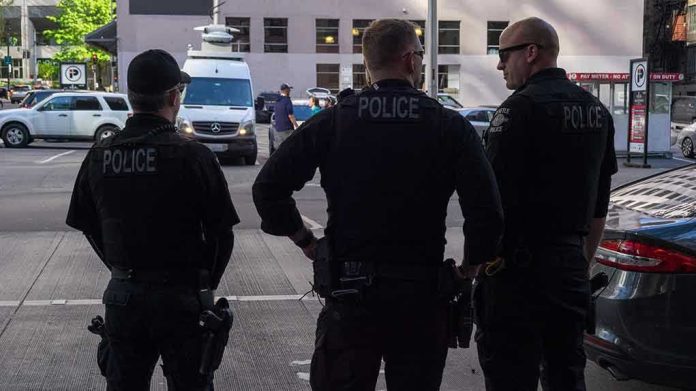
March 28 delivered one of those political images you can’t workshop: protesters chanting “abolish the police” while walking under police escort. That single contradiction explains more about modern protest culture than a thousand manifestos. The chant sells moral certainty; the escort reflects an older truth: crowds, traffic, and tempers don’t manage themselves. When demonstrations sprawl across city blocks, someone must separate the angry from the opportunistic and the peaceful from the reckless.
The video matters because it’s not an argument, it’s a receipt. It shows the practical bargain that even anti-police movements routinely make in public: the state provides basic security so the demonstration can exist at all. Without that boundary, the protest doesn’t become freer; it becomes vulnerable—to rival factions, criminals looking for cover, and the small number of participants who show up hoping the night ends with fire instead of speeches.
What Happened on the Ground: Los Angeles as the Stress Test
Los Angeles became the headline example of how fast a “day of action” turns into an order-and-control problem. Reports described escalation around federal property, including a DHS facility, after some protesters threw objects. Law enforcement issued warnings, then moved to disperse the crowd, and authorities used tear gas. LAPD declared a tactical alert, the sort of staffing posture departments use when they anticipate long hours, multiple hot spots, and the need to rotate exhausted officers.
That sequence—warnings, dispersal order, arrests—follows a familiar script, and it isn’t written to win applause. It exists because cities can’t allow a moving mass to test fences, block emergency routes, or endanger bystanders. Adults watching from home understand the unglamorous math: if the police step back and something terrible happens, the same voices screaming “abolish” will demand to know why no one “did something.” Civilization runs on responsibility, not slogans.
Denver and Dallas: Smaller Headlines, Same Reality
Other cities supplied their own proof that nationwide protests can’t be managed through vibes. Denver reported arrests after demonstrators blocked a roadway. Dallas saw at least one arrest amid protest and counter-protest energy. Each city has its own rules and thresholds, but the underlying issue stays consistent: public assembly becomes public disorder when participants decide roads, entrances, and traffic signals are optional. Police exist to keep one group’s political theater from becoming everyone else’s emergency.
That’s why the “escort paradox” hits so hard with older Americans. Many remember protests that looked like debates with signs, not rolling street occupations. When activists shut down infrastructure, they compel enforcement. When enforcement arrives, they film it as oppression. The public sees a loop: provoke, resist, capture footage, fundraise, repeat. Common sense says lawful protest should not require a police overtime budget the size of a small-town payroll.
The Movement Behind “No Kings”: Scale, Messaging, and a Question of Control
The “No Kings” banner has drawn support from a web of progressive organizations and allies, with organizers advertising thousands of events. Some coverage highlighted the breadth of the coalition and claims about massive turnout. Another angle focused on the professionalized activism ecosystem—well-funded, networked, and increasingly comfortable treating disruption as a feature rather than a bug. That matters because scale without discipline doesn’t produce “momentum”; it produces chaos and the political backlash that follows.
The stated grievances range from opposition to Trump administration policies to anger over ICE-related incidents, and prominent figures appeared at major rallies. None of that automatically excuses violence, intimidation, or property attacks. Conservative values don’t require agreeing with a protest’s cause to defend the right to assemble; they require insisting that rights come paired with duties. If organizers can choreograph stages, speakers, and press releases, they can also police their own side—or admit they can’t.
The Real Lesson of the “Abolish” Chant: You Can’t Abolish Consequences
“Abolish the police” has always functioned more as a performance than a plan. If taken literally, it collapses under the weight of basic questions: Who responds to domestic violence calls? Who stops looting? Who secures the perimeter when agitators show up with bricks? The March 28 footage answers the slogan more cleanly than any policy paper. Even in the middle of anti-police theater, demonstrators still rely on police to prevent the worst actors from hijacking the crowd.
BEYOND PARODY: No Kings Protesters Yell ‘Abolish the Police’ as They’re Being Escorted and Protected by Police (VIDEO) https://t.co/kp5ixCm6Vl
— John Wade (@LtJohnWade) March 29, 2026
That’s why the image lingers. The protester imagines the police as a political symbol; the officer treats the moment as a job with real stakes—injuries, stampedes, and the danger of a single spark in a packed street. Americans over 40 recognize that order is not oppression; it’s the precondition for everything else, including dissent. When movements refuse that premise, they don’t look revolutionary. They look unserious, and the country moves on.
Sources:
As ‘No Kings’ protests grow, a bigger question looms: What comes next?
No Kings protests across US target Trump administration, draw arrests and clashes
State, local police prepping security for third No Kings rally