
Celebrity firepower at a political rally is not background noise; it is part of the staging that signals identity, sharpens the message, and primes the crowd. Ted Nugent’s turn at a Kansas arena before President Trump’s remarks illustrates how campaigns use a familiar entertainer to fuse culture and politics into a single mobilizing ritual.
At a Glance
- Ted Nugent addressed the crowd at the Heartland Credit Union Arena ahead of President Trump, joining a slate of Republican speakers.
- Local outlets documented Nugent’s presence and carried video of his remarks to the crowd.
- Nugent framed himself as a “radical” and “extremist” for a canon of conservative touchstones, positioning culture as politics by other means.
- Attendance was reported in the range of the arena’s capacity, consistent with a near-full rally environment.
What Happened: Nugent as a Featured Rally Speaker
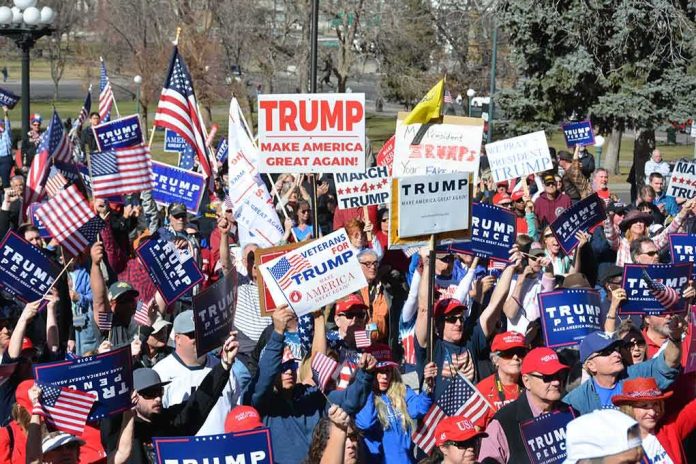
On October 19, 2026, Ted Nugent took the stage before President Trump at a rally in Park City, Kansas, an event aimed at boosting Sen. Roger Marshall and other Republicans. Local reporting placed Nugent among the pre-Trump speakers alongside Kansas officials; one outlet counted seven state figures followed by the rock musician and hunting advocate before the headliner arrived. Television video carried Nugent’s appearance under the straightforward title, “Ted Nugent speaks at President Trump’s rally,” underscoring his role as a featured speaker rather than an ambiguously reported drop-in. Coverage described the arena as near full, with crowd estimates approaching roughly six thousand in the space.
Onstage, Nugent leaned into a signature persona—brash, unvarnished, and rhetorically maximalist. He embraced the labels “radical” and “extremist” and then defined them in a cultural register: God, family, country, the Constitution and Bill of Rights, the Ten Commandments, the Golden Rule, work ethic, law and order, self-defense, and private property. The list was less a policy platform than a value bundle, designed to resonate instantly with a friendly crowd and to frame the coming candidate remarks in a moral vocabulary already familiar to conservative audiences.
How Campaign Rallies Use Cultural Signals
Rallies are deliberately produced genres. They fuse candidate messaging with symbols, rituals, and recognizable voices—state dignitaries who authenticate the ticket, activists who speak the language of the base, and cultural figures who embody the in-group’s worldview. In that grammar, a celebrity appearance functions as connective tissue between politics and identity: it warms the room, codes the event’s values, and acts as a bridge from entertainment to exhortation. Scholarship on rallies describes this genre logic explicitly—candidates, collectivities, contests—each staged to be legible to attendees and cameras alike. Nugent’s prelude fit that mold: a value-forward oration that cued the crowd to receive the headliner as custodian of that canon.
Labels like “opened for” versus “spoke before” often travel more in rhetoric than in event operations. Music-world phrasing carries a sense of concert hierarchy; political-world phrasing stresses sequence and endorsement. Here, local reporting and broadcast video consistently documented Nugent speaking ahead of Trump. Whether one calls that “opening” is secondary to the concrete fact pattern: a planned appearance, remarks from the stage, and a clear warm-up function within the rally’s run of show.
What Nugent Brings to a Rally Stage
As an entertainer identified with gun rights, hunting culture, and patriotic spectacle, Nugent brings three assets to a campaign venue. First, recognition: he is a known quantity to conservative-leaning audiences who have followed his public persona for decades. Second, message discipline via character: when he says “I’m an extremist” and defines it as reverence for God, family, and constitutional liberty, he reframes a pejorative as a badge—turning political heat into identity pride. Third, energy: measured less in decibels than in tempo—short punch lines, call-and-response cadences, and moral binaries that move a room from milling to focused. That is precisely the point of a rally warm-up.
Local reports situate Nugent among the day’s validators—Kansas officials, party regulars, and then the celebrity infusion—before the presidential arrival. The coverage cadence is familiar to anyone who has produced such an event: stack recognizable locals early, add a culture-forward spark to crest the crowd’s attention, and then time the headliner for the peak. In Kansas, the sequencing followed that template, and the arena description—near capacity, high enthusiasm—suggests it worked on its own terms.
Do Celebrity Appearances Change Minds, or Just Turn Up the Volume?
The political science on celebrity involvement is mixed, and that is not a dodge—it reflects different contexts and measurement frames. Some studies find that celebrity endorsements can shape attitudes and even turnout intentions in experimental settings and meta-analyses; others report modest or null effects on candidate evaluations, especially among audiences already sorted by partisanship. The Oprah effect in the 2008 Democratic primary—where exposure to Oprah’s audience correlated with measurable gains for Barack Obama—remains the canonical case for a real electoral lift, but it was a perfect confluence: unmatched media reach, high trust, and a competitive primary where marginal persuasion mattered.
As a rule of thumb, celebrities most reliably affect inputs earlier in the causal chain—attention, attendance, fundraising, volunteer engagement—rather than durable vote choice in a polarized electorate. One line of research even flags potential boomerang effects when a celebrity is polarizing enough to activate out-group backlash. In practice, campaigns use celebrities less as persuaders than as amplifiers and mobilizers: they get cameras to show up, they fill the room, and they translate abstract platforms into cultural signals people feel. Nugent’s Kansas set-piece looked like precisely that—mobilization and message reinforcement for a crowd predisposed to agree.
JUST IN: The Legendary Ted Nugent drops the 🎤 saying “I got a call from President Trump saying 'can you come to Kansas and RAISE SOME HELL”
THIS IS THE MOST EPIC VIDEO 🔥 pic.twitter.com/n5uaaE1nLD
— 🇱🇷🍩JULIE DONUTS Q🍩🇱🇷 (@rejulie_Donutsq) October 20, 2026
Why This Appearance Mattered to the Event Itself
Inside the arena, Nugent’s rhetoric had a specific job: to fuse a moral storyline to the campaign’s ask. His value list linked faith, constitutionalism, and self-defense into a coherent identity claim, then yoked that claim to the candidacies on the ticket. That dramaturgy matters because it compresses the distance between “who I am” and “how I vote”—a powerful accelerator in turnout politics. For Kansas Republicans, the shared language likely strengthened in-group cohesion; for cameras, it offered a clean clip that telegraphed the rally’s ideological center of gravity. The subsequent transition to President Trump’s remarks then landed in a room already tuned to a frequency Nugent helped set.
Sources:
kansas.com, kmuw.org, kspress.com, kwch.com, yahoo.com