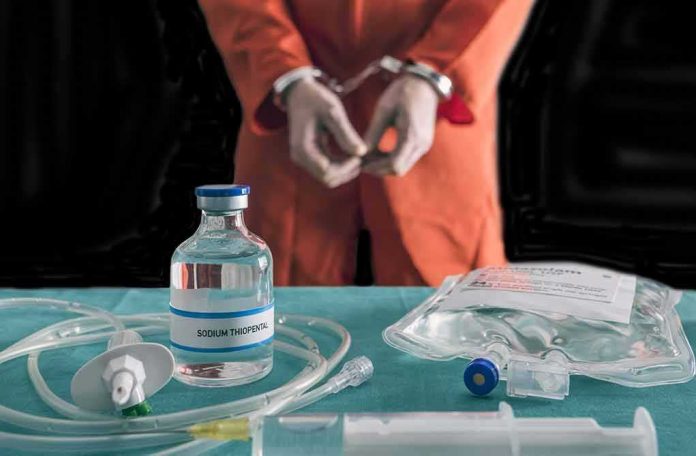
Tennessee tried twice to end a death sentence and instead exposed a broken execution system.
Story Snapshot
- Officials paused Christa Pike’s execution after two doses and sent her to a hospital.
- Governor Bill Lee ordered a third-party review and halted remaining 2026 executions.
- Witnesses and filings describe loud breathing and confusion inside the chamber.
- The state says it followed its approved protocol during the attempt.
What happened inside Tennessee’s execution chamber
State officials attempted to execute Christa Pike by lethal injection on a Wednesday evening. Media witnesses and an emergency court filing said two syringes of pentobarbital were pushed, yet Pike appeared to remain alive and breathing, with loud snoring reported from the viewing room. The Tennessee Department of Correction told the state Supreme Court after midnight that Pike was being sent to a hospital for care. The scene raised immediate questions about dosing, vein access, and the team’s readiness under pressure.
Attorneys argued the state failed to carry out a lawful execution and pressed courts to stop any further attempts. At the same time, the department maintained it followed every step of the approved protocol during the attempt, a claim later echoed in local reporting that cited the agency’s statement. Both accounts can be true in part: staff can follow a paper protocol while the real-world process still breaks down. That is why procedures exist, and why failures still demand answers.
Governor Lee’s response and the immediate policy fallout
Governor Bill Lee halted remaining executions for the year and ordered a comprehensive, third-party review to determine what went wrong. That swift step aligns with basic executive duty: when the state uses the ultimate punishment, it must get the process right every time. The order signals that the problem is bigger than one technician or one syringe. It points to systems, training, and testing. That is the correct frame for a fix that respects both the law and taxpayers.
The move also reflects Tennessee’s recent history with execution protocols. The state paused executions in 2022, commissioned an independent review, and then announced a new single-drug protocol using pentobarbital in 2024 to improve reliability and transparency. The Pike incident shows that a rules rewrite on paper is not enough without airtight practice in the chamber. Conservative governance prizes competence. Government must prove it can carry out a lawful sentence without chaos or doubt.
The clash of claims: protocol compliance versus real-world failure
The Tennessee Department of Correction says staff complied with every approved step. That claim matters because process discipline protects the state in court and in public view. Yet witnesses described confusion, closed and opened curtains, and sustained breathing sounds after the drugs were given. When those two pictures collide, the responsible path is to test the state’s claims, verify chain-of-custody for the drug, review training logs, and examine vein-access decisions. That is what the governor’s review should do.
Tennessee failed to carry out an execution TWICE in 4 months.
❌ May 21: Tony Carruthers. They spent over an hour trying and failing to get a backup IV in. Called off.
❌ Sept 30: Christa Pike. Two doses of pentobarbital. She ended up in a hospital.
Lethal injection already…
— Kentucky Girl (@Kentuckygirl1) October 1, 2026
Pike’s lawyers said this is what they warned about: hard vein access, potential “blown” lines, and questions about drug quality, with no clear medical rescue plan when things went sideways. Their job is to advocate, and their claims should be checked against records, not taken as gospel. Still, the overlap between their warnings and what media observers reported justifies scrutiny. Common sense says a penalty this serious cannot rely on hope and best-case scenarios.
How Tennessee can fix what went wrong
The review should focus on four areas. First, drug integrity and documentation, including storage, handling, and independent potency testing before use. Second, intravenous access strategy that does not hinge on last-minute guesswork, with documented backup plans if the first site fails. Third, team training measured by repetition on realistic models and scenario drills that include communication with observers. Fourth, command authority in the room, so someone stops, reassesses, or aborts when signs conflict with expectations. These are basic, apolitical steps that restore trust.
Citizens who back the death penalty expect a swift, lawful, and dignified process. Families of victims deserve finality that does not invite more litigation. Taxpayers deserve a system that works the first time. Governor Lee’s pause is not leniency; it is maintenance on the state’s most serious tool. If the final report shows the rules were sound but the execution team failed them, fix the team. If the rules themselves set the team up to fail, fix the rules. Either way, the standard is simple: never repeat this night.
Sources:
theguardian.com, abcnews.com, bbc.com, yahoo.com, fox5atlanta.com