
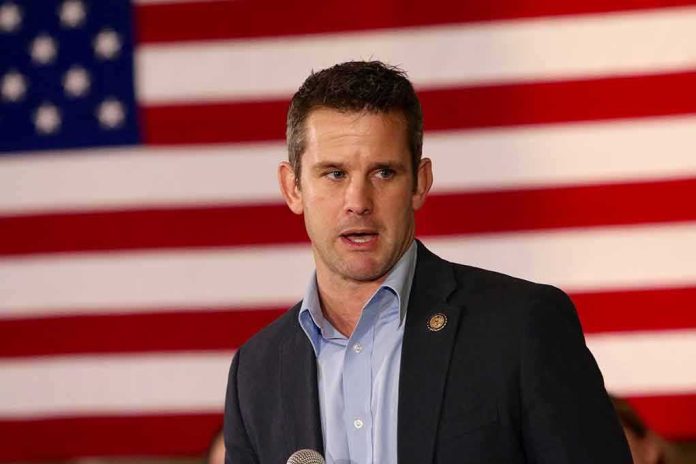
A federal market cop is asking a simple, explosive question: did Adam Kinzinger bet cash on his own pardon and break the rules doing it?
Story Snapshot
- Reporters say federal regulators are reviewing Kinzinger’s Kalshi bets tied to his own potential pardon.
- Kinzinger admits he placed the trades and says he followed the platform’s rules and had no inside info.
- Kalshi reportedly flagged the account to regulators and calls the review routine.
- No public enforcement document confirms charges or a formal action at this time.
What investigators are looking at and why it matters
Politico and CNN reported that the Commodity Futures Trading Commission is examining trades on Kalshi that were linked to Adam Kinzinger in December 2024 and January 2025. Those trades reportedly focused on whether President Joe Biden would pardon Kinzinger. Kinzinger confirmed he wagered on outcomes that included whether he would get a pardon, and he tied his trades to that personal outcome. That narrow focus moves this beyond politics-as-sport and into a personal-stake market question.
Kalshi functions like a federally regulated market for event contracts. That status brings the same kind of conduct rules that govern other trading venues. Press reports say Kalshi monitors for insider-style behavior and bans users from betting on contracts where they are direct participants. Reporters also noted that the Commodity Futures Trading Commission bars use of material nonpublic information in markets it oversees. Those policies explain why a self-referential pardon bet would draw scrutiny.
What Kinzinger says about the trades
Kinzinger says he placed less than $1,000 across two pardon-related Kalshi markets and read the platform’s rules first. He says he believed the rules allowed his bets because he did not work for a source agency, could not influence the outcome, and had no nonpublic information. He denies any advance knowledge and says he never discussed the pardon with anyone, including anyone near the White House. He has called the wager a dumb bet, not a secret play.
His defense leans on a common-sense frame: if you cannot sway the decision and you have no inside tip, you are just another speculator. That argument will rise or fall on two points. First, what Kalshi’s exact rules said at the time. Second, whether the Commodity Futures Trading Commission views “betting on your own outcome” as a form of direct participation that violates fair-market standards. Without documents, those answers remain open in the public record.
What Kalshi and the regulators are signaling
The Hill reported that a Kalshi source said the company reported the account and trades to the Commodity Futures Trading Commission and described the review as routine. Routine or not, this fits a broader shift. The agency has told the public it can police insider trading and manipulation on event markets, and platforms have suspended political candidates who wagered on their own races. That recent track record shows regulators and exchanges are treating own-event bets as a red flag.
Feds Investigate Kinzinger Over Alleged Kalshi Bets On Own Pardon | Tyler Durden, Zerohedge
Former Republican Rep. Adam Kinzinger is reportedly under investigation by the Commodity Futures Trading Commission over prediction-market trades tied to an unusually personal event:… pic.twitter.com/Vyb7kRPOaO
— Owen Gregorian (@OwenGregorian) October 1, 2026
So far, no public filing shows a formal enforcement action against Kinzinger. That matters. A probe is not a charge. Still, the timing and the personal nature of the contract explain why this drew attention. Reporters pinpointed December 2024 and January 2025 activity. Even small sums can trigger an inquiry if the principle at stake is market integrity. The Commodity Futures Trading Commission’s mandate is to protect markets from unfair advantages, not to size up bet tickets.
The line between bad optics and banned conduct
Americans understand fairness. If a person can profit from inside knowledge about their own fate, most people call that out of bounds. The challenge here is proof and rule text. Press accounts do not cite any specific nonpublic information Kinzinger held, and they do not print the exact Kalshi rules in force then. That gap leaves two paths. Either this is poor judgment that stays within rules, or it is a direct-participant violation under emerging event-market standards.
Conservative values place a premium on clear rules, equal treatment, and accountability. On those terms, the right outcome is simple. If the rules barred direct participants from betting on their own outcomes, enforce them. If the rules were unclear, fix them fast and warn the market. Either way, set a bright line so regular traders and public figures play by the same code. That protects trust without turning every dumb bet into a federal case.
What to watch next
Watch for three things. First, any Commodity Futures Trading Commission document that defines the theory here, such as a letter, order, or settlement. Second, Kalshi’s archived rules for the exact trade dates, especially any clause on direct participants or pardon contracts. Third, evidence about communications or knowledge before the trades. Those items will tell the public whether this was a simple lapse of judgment or a breach that merits sanctions.
Sources:
twitchy.com, edition.cnn.com, politico.com, finance.yahoo.com, thehill.com, nymag.com