

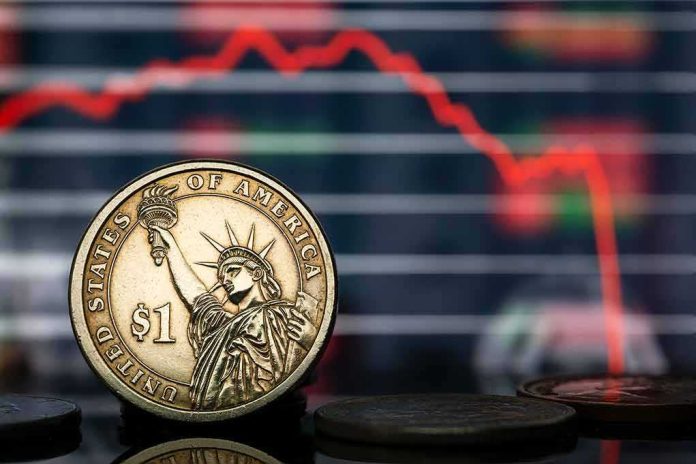
President Trump’s face is now stamped on a United States dollar coin, making him only the second sitting president in more than a hundred years to appear on American money while still in office.
Quick Take
- The Treasury Department confirmed the US Mint began striking the $1 Trump coin as part of America’s 250th anniversary celebration.
- A Trump-appointed arts panel approved the design earlier this year, and the coins went on sale and into circulation in September.
- Senate Democrats call the move “un-American” and say it breaks a century-old tradition against living officials on currency.
- Legal scholars argue an 1886 law bars any living person’s portrait on currency, though coinage rules are murkier.
- Treasury points to Calvin Coolidge’s 1926 half dollar as proof this has happened before.
A Coin Rolls Off the Press for America’s 250th Birthday
Treasury Secretary Scott Bessent announced on July 15, 2026, that the Mint would begin producing $1 coins bearing Trump’s face on the front, tying the release to the nation’s semiquincentennial celebration. The Mint later released the finished designs on August 4, and by September 2 the coins were in circulation and for sale to collectors. Officials framed the timing as a patriotic tribute, not a political statement.
Buyers rushed the Mint’s website once sales opened, and gold-colored versions sold out within hours, with some resale listings jumping well above face value. The Mint told buyers to check their pocket change too, since a batch entered general circulation alongside the collector run. That detail alone tells you this isn’t a quiet limited-edition novelty tucked away in a display case.
An Arts Panel Trump Appointed Approved the Design
Before any coin got struck, the design had to clear the US Commission of Fine Arts. That panel, made up of members selected by Trump himself, unanimously endorsed the artwork on March 19, 2026. Supporters call that due process working as intended. Critics see a conflict of interest baked into the approval from the start, since the president effectively picked the judges of his own portrait.
The commission’s sign-off gave Treasury the legal cover it needed to move forward with manufacturing. Officials treated the approval as settled business, brushing past objections raised before the vote and after it. That pattern, approve first, argue later, has defined this coin’s entire rollout.
Democrats Say the Coin Breaks the Law and a Longtime Norm
Senator Jeff Merkley, Senator Catherine Cortez Masto, and seven Senate colleagues sent Bessent a letter warning that circulating a coin with Trump’s image betrays “the time-honored tradition of not circulating U.S. currency with images of currently elected officials”. They called the plan “not only inconsistent with congressional intent” but flatly “un-American,” language rarely used in a coin dispute.
Their objection isn’t just about taste or precedent. It rests on a real statutory question that predates Trump entirely, rooted in Reconstruction-era fears about turning money into political propaganda. That history matters, because it means this fight was never really about one president’s ego. It’s about whether Washington can quietly rewrite a 160-year-old guardrail.
Legal Scholars Point to an 1886 Law Barring Living Faces on Currency
Jeremy Paul, a constitutional law professor and former dean at Northeastern University School of Law, put it bluntly: “The law prohibits, currently, on currency, the likeness of any person, not just the president, who is alive”. That statute traces back to an 1866 measure passed after a Treasury official’s own face wound up on a nickel banknote and sparked public outrage.
Trump is on a $1 coin — first living president in a century
The US Mint put Donald Trump on a commemorative $1 coin for America's 250th. A roll of 25 is $61; a bag of 100 is $154.50. Hours after launch, the Mint site said not currently in stock.
Scott Bessent still wants a $250… pic.twitter.com/6UBIdS5jeB
— Tesla_Optimus (@Tesla_Optimus_K) September 3, 2026
Treasury has countered that the statute governs paper currency and securities, not coins, a distinction some numismatic historians support. Whether that legal line actually holds is the real unresolved question here, and it’s one a court, not a press release, will eventually have to settle.
Coolidge Precedent Gives Treasury Its Defense
Bessent has leaned hard on history to justify the coin, telling Fox News that a Calvin Coolidge half dollar minted for the nation’s 150th anniversary in 1926 already broke this ground. “So we can put living presidents’ images on a coin,” he argued. Washington Post reporting confirms Trump’s coin now marks only the second time a sitting president has appeared on American coinage.
That single Coolidge coin, struck a century ago and never repeated since, is the entire historical foundation Treasury is building on. Whether one century-old exception justifies reviving the practice for a modern president is exactly what critics in Congress are refusing to accept without a fight.
Sources:
theguardian.com, politico.com, nypost.com, investor.wedbush.com, foxbusiness.com, reuters.com, cnn.com