
California lets you register to vote even if you have no driver’s license, no state ID, and no Social Security number at all.
Story Snapshot
- California assigns a random “unique identifier” to registrants who lack a driver’s license, state ID, or Social Security number.
- State guidance says most voters never have to show ID at the polling place before casting a ballot.
- Officials say identity gets checked through DMV and Social Security record matching, not a front-door ID card.
- Secretary of State Shirley Weber says only 12 fraud cases turned up among 26 million possible voters in five years.
- Voters will decide the fight directly in November, when a strict voter ID measure appears on the California ballot.
What California’s Registration Rules Actually Allow
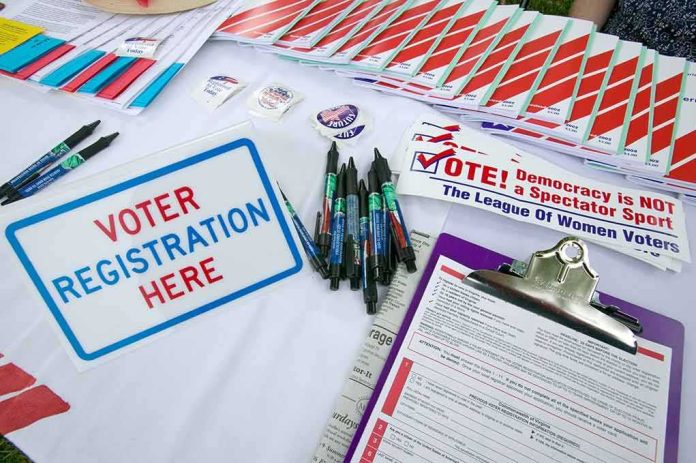
California’s voter registration form asks for a driver’s license number, state ID number, or the last four digits of a Social Security number. If a person has none of those, the state does not turn them away. It assigns them a “unique identifier” instead, a number generated by election officials just to track that voter’s file.
State regulation backs this up directly. If an applicant “has not been issued either a current and valid driver’s license or a social security number,” the rule says, “the state shall assign the voter a unique number”. That number exists purely for record-keeping. It is not a driver’s license, a passport, or anything a voter can pull out of a wallet later.
The Polling Place Gap Critics Point To
Here is the detail that fuels most of the outrage: California’s own election website admits “in most cases, a California voter is not required to show identification to a polling place worker before casting a ballot”. Registration without a photo ID is one thing. Voting without ever showing one is a separate, bigger claim, and it comes straight from the state’s own materials.
There is one narrow exception. First-time voters who registered by mail without listing a driver’s license number, state ID number, or Social Security digits may get asked for identification at the polls. But that group is small, and the acceptable documents on the state’s own list are surprisingly loose. A utility bill counts. So does a sample ballot booklet mailed by the county. Neither has a photo. Neither proves the person holding it is the registered voter.
Critics have run further with this than the official documents support. Claims that any voter can flash a gym card or an insurance card at the polls do not appear anywhere in the Secretary of State’s published rules. The real gap is narrower than the loudest version of the story, but it is still a gap: a non-photo utility bill can substitute for a driver’s license.
The State’s Defense: Multiple Checkpoints, Few Fraud Cases
California election officials argue the ID-at-the-door model misses how verification actually works. Registration numbers get checked against Department of Motor Vehicles records and Social Security Administration files behind the scenes. Death records update weekly. Felon records update at least that often.
Secretary of State Shirley Weber made the state’s case directly to a Senate committee, calling the “no voter ID” framing a myth given how much cross-checking already happens. She backed it with a number meant to end the argument outright: out of 26 million possible voters, only 12 fraud cases surfaced over five years, a rate she called “virtually insignificant”. Supporters of tighter rules counter that a low official count does not prove a low actual count, especially without independent audits confirming it.
Prop 39 and the Political Fight Ahead
The disagreement is no longer just theoretical. A measure headed to California’s November ballot would require voters to show government-issued identification in person or provide identifying numbers by mail. A Sacramento County judge already rejected a challenge to how the state described the measure’s effects, ruling the official summary was accurate.
Happy to share that I have been volunteering for over a year now to support the Voter ID Initiative over here for my home state of California. Fighting for election integrity is the right thing, regardless of party lines.
— Andy V Renditions (@artsymammotech) September 2, 2026
National research on voter ID complicates both sides of this fight. Large studies using years of nationwide data have found strict ID laws produce no measurable drop in registration or turnout, cutting against warnings that ID requirements suppress voters. Other academic reviews note the public fight over ID persists partly because the policy is easy to argue about and hard to measure with certainty, regardless of which side is right.
Why the Debate Won’t Settle Soon
None of this changes the plain fact driving conservative frustration: California registers people with no ID and, for most voters, checks nothing at the ballot box beyond a signature. Backend database matching may catch fraud after the fact. It does nothing to reassure a voter watching someone hand over a utility bill instead of a photo ID. Common sense says the front door should match the back-end promise, and right now in California, it does not.
Sources:
thegatewaypundit.com, sos.ca.gov, voteriders.org, voterstatus.sos.ca.gov, ocvote.gov