

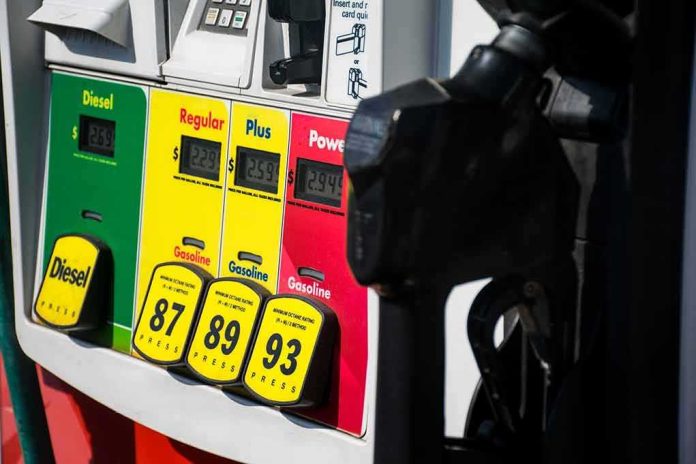
Every time you squeeze the gas pump now, you are paying for a shooting war half a world away.
Story Snapshot
- Average U.S. gas prices are back at about $4 a gallon, after months of Iran war headlines and fresh U.S. strikes.
- The Strait of Hormuz, a narrow waterway that moves a huge share of the world’s oil, has gone from busy highway to near standstill.
- Families are eating hundreds of extra dollars in fuel costs, while inflation warnings now stretch into 2027.
- Behind the scary price board at your local station is a mix of war risk, market games, and political spin fighting for control of the story.
Gas Hits $4 Again And Your Wallet Feels The War
The headline is simple: U.S. gas prices are back at roughly $4 a gallon, after dipping below that mark for a short time. The motor club AAA reports the national average has jumped more than 10 cents in just a week in the latest run-up. That moves the typical family’s monthly fuel budget from annoying to painful. Moody’s Analytics estimates households have already paid hundreds of extra dollars since late February as the Iran conflict dragged on.
These jumps are not happening in a vacuum. Brent crude, the main global oil benchmark, is trading in the high $80s to around $90 a barrel after a roughly 10 percent spike in just days. That rise does not come from some sudden love of driving. It tracks almost one for one with new rounds of U.S. and Iranian strikes, and with fresh fears that key oil flows could be cut off or taxed by force.
The Strait Of Hormuz: A Global Oil Chokepoint Under Fire
The Strait of Hormuz is a narrow sea lane off Iran where a large share of the world’s exported oil must pass. Before the war, ship trackers counted well over a hundred tanker transits a day through this corridor. Now, Kepler maritime data and U.S. Central Command video show a “single-digit trickle” of tankers moving, after American strikes destroyed at least one Iranian surveillance tower and Iran answered with drone attacks on commercial ships.
Economically, that bottleneck acts like a kink in a garden hose. The Energy Information Administration says closures and related production outages in the region are “key drivers” of the current price surge. The European Central Bank describes the Middle East war and Hormuz disruption as major reasons oil prices jumped sharply this spring and began to weigh on wider economic growth. When that much oil cannot move freely, the entire price ladder from crude to gasoline shifts higher.
War Risk Premiums: You Pay For Fear Before Supply Actually Runs Out
Oil markets do not wait for a full cutoff to raise prices. Traders build in what they call a “risk premium” based on what might happen next. A World Bank study finds oil prices swing almost twice as wildly when geopolitical risk rises compared with calmer periods. Analysts tracking past Middle East conflicts show a typical pattern: prices spike fast on fear, then settle back as routes reopen or spare capacity comes online.
That same playbook is now visible. Brent crude jumped roughly 10 percent as strikes and tanker attacks mounted, even while some barrels still found side routes. The Energy Information Administration’s own modeling suggests prices could cool later, with Brent averaging below $90 in late 2026 and closer to the mid-$70s in 2027. That means the pain at the pump is real but may not be permanent, unless the shooting or blockade escalates again.
Competing Narratives: War, Other Shocks, And Market Games
Mainstream outlets repeat one clear message: the Iran war and Strait of Hormuz shock are the main culprits behind $4 gas. There is solid logic in that claim. Disrupted tanker traffic, production shut-ins, and fear of wider regional fighting all push prices higher. Yet the counter-view points out that other forces also matter. Drone strikes on Russian refineries, earlier OPEC supply cuts, and seasonal summer demand squeeze the system too.
GasBuddy station data even shows the national average at $3.82 at one recent point, down more than 20 cents from a month earlier, proving prices move up and down rather than straight up. CBS editor Kristen Myers argues that traders grow tired of constant war scares and may cap prices unless something truly catastrophic hits. From a conservative, common-sense angle, it is fair to say: war risk clearly raises prices, but some players also use that fear to justify bigger jumps than fundamentals alone might support.
Politics, Inflation, And The Trust Gap
The Iran conflict and $4 gas land in a deeply political moment. President Trump has talked about the Strait of Hormuz being “open” while also backing naval blockades and toll ideas, which sends mixed signals about how freely oil can move. That kind of messaging war makes it harder for average Americans to know whether high prices reflect real shortage, policy choices, or market opportunism. It feeds the sense that someone, somewhere, is gaming the chaos.
The Strait of Hormuz story is beginning to move beyond a geopolitical headline.
Restricted tanker traffic is now being reflected in energy and rates. Oil and European gas are higher, bond yields are rising, and energy stocks are outperforming fuel-sensitive sectors.
The first…
— Data Over Noise (@DataOverNoise) July 20, 2026
Meanwhile, corporate leaders already plan for long-lasting higher costs. Bank of America chief Brian Moynihan says companies are baking elevated energy prices into their price tags “all the way into 2027.” If that view holds, a temporary shock risks becoming a semi-permanent new normal. For a conservative-minded voter, the lesson is clear: when Washington chooses conflict in the world’s key oil chokepoint, the first battlefield isn’t just the Gulf. It is your family’s budget, every mile you drive.
Sources:
washingtontimes.com, aljazeera.com, reuters.com, cnbc.com, news.un.org, en.wikipedia.org, usatoday.com, nytimes.com, x.com, britannica.com, eia.gov