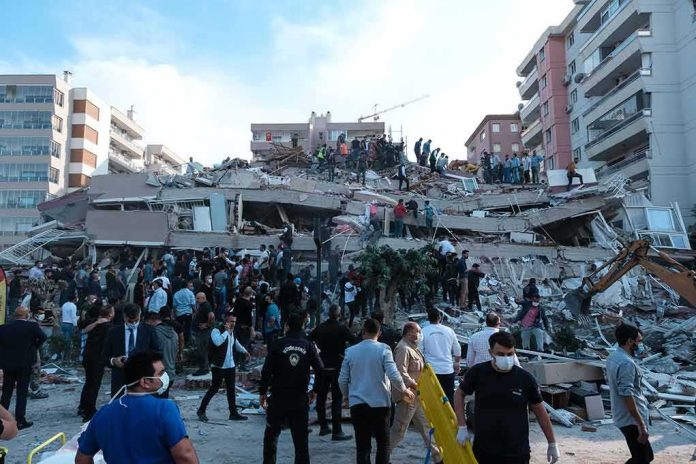
Two massive quakes hit Venezuela minutes apart, and the story shifted faster than the ground.
Story Snapshot
- United States Geological Survey reported magnitude 7.1 and 7.5 quakes near Morón minutes apart [1].
- Officials in Caracas reported collapsed buildings and urgent situations in Altamira [1].
- Tsunami alerts reached Puerto Rico and the Virgin Islands as a precaution [1].
- Early reports conflicted on size and damage, which often happens in fast-moving disasters [2][3][4].
What Happened And Where The Numbers Came From
Reporters cited the United States Geological Survey within hours: a 7.1 quake west of Morón at about 13 kilometers deep, then a stronger 7.5 quake 16 kilometers southwest of Morón at about 10 kilometers deep [1]. A broad summary placed the epicenter in Yaracuy state, 21 kilometers west of Morón, on June 24, 2026 [4]. Early depth and magnitude values often shift. These readings came fast, from global stations, and will get fine-tuned as more data arrives. That does not make them weak; it makes them live.
Officials in Caracas reported collapsed buildings and “alarming situations” in the Altamira neighborhood soon after the shaking [1]. Photos and clips spread next, but solid counts lagged. That is normal. Search and rescue must come first. Confirming deaths and injuries takes time and care. When early television crawls said “no damage yet,” they were not wrong; they were early [2]. Expect a moving target on damage totals for days. Patience beats panic when the dust is still in the air.
Why Conflicting Magnitudes Happen In Real Time
Different agencies can post different numbers in the first hour. One outlet flagged a separate 6.3 event near Mene Grande, which could be a distinct tremor in the broader sequence or a misread amid the noise [3]. Wikipedia summaries echoed the core details but also reflect rolling edits [4]. This is not a conspiracy; it is seismology under stress. Sparse sensors in parts of the region add error bars. Analysts backfill with better waveforms and adjust. Think “draft,” not “final.”
The United States Geological Survey remains the baseline for global quakes. It runs dense data pipelines and updates fast [1]. Social media posts that named the Bocono Fault and a depth “about 22 miles” add color, but they do not replace vetted bulletins [5]. When numbers differ, side with the agency that posts its methods and revisions. That approach aligns with common sense: trust the shop that shows its work and corrects in daylight. Accountability beats hype every time.
Damage Signals, Tsunami Alerts, And The Timeline Problem
The United States Pacific Tsunami Warning Center pushed alerts to Puerto Rico and the Virgin Islands after the first shock [1]. That move is standard when a large quake strikes near the Caribbean arc. An alert is not a prediction of destruction; it is a seat belt. Coastal gauges, not headlines, decide if waves matter. In past events, alerts cleared with little action. The process worked as designed. Better a cautious bell than a silent shoreline and a sprint for high ground.
A tsunami struck Venezuela following earthquakes measuring 7.1 and 7.5 in magnitude.
The number of dead and injured in Venezuela is unknown. pic.twitter.com/PwcBNz8lTx
— streetchaos (@Streetchaos2) June 25, 2026
Collapsed buildings in Caracas demand hard answers. Which structures failed? Old concrete? Soft stories over parking? Bad retrofits? Forensic teams will look for clear failure modes. In cities with mixed building stock, damage clusters expose code gaps and corruption pockets. If a tower fell while a next-door block stood, design and upkeep likely split their odds. When the reports arrive, judge them by how they trace load paths, not by headlines written in a rush.
How To Read Early Disaster News Without Getting Spun
Start with who measured the shaking and how they share updates. The United States Geological Survey posts revisions; that builds trust [1]. Check whether officials on the ground confirm damage, and note the timestamp gap with early “no damage yet” blurbs [2]. Treat outlier magnitude claims as placeholders until a formal bulletin aligns the picture [3][4]. Media can overshoot with “collapsing buildings” language in the first hour, but that risk does not erase real damage calls from responsible authorities.
Hold fast to two ideas at once. Big quakes can trigger real urban failures fast. Early numbers can be messy. Both are true. A mature view respects rescue work, demands transparent data, and ignores rumor farms. That stance fits American conservative values: local facts, accountable experts, and strong communities doing the hard work while national systems back them up. When the ground moves, clarity comes from patience, proof, and people who show up and keep their receipts.
Sources:
[1] Web – BACK TO BACK MAJOR QUAKES ROCK VENEZUELA… MORE
[2] Web – Back-to-back powerful earthquakes hit Venezuela, …
[3] Web – Powerful 7.1 and 7.5-magnitude earthquakes hit Venezuela
[4] Web – Venezuela hit by 6.3-magnitude earthquake
[5] Web – 2026 Venezuela earthquake