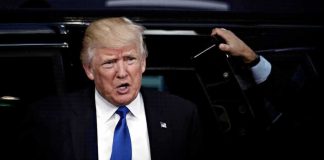

Trump is betting that gas prices will fall fast enough for you to feel it in your wallet before you walk into the voting booth.
Story Snapshot
- Trump claims his energy agenda is already pushing gas toward four-year lows, with sub-$3 averages in sight.
- His own Energy Secretary and outside forecasters offer a more cautious, conditional timeline.
- The Iran war and the Strait of Hormuz chokepoint have driven prices sharply higher, complicating any quick-drop promise.
- Voters must decide whether Trump is steering the market—or simply surfing a volatile global wave.
Trump’s promise: cheaper gas, and soon
The White House now frames gas prices as proof that Trump’s energy agenda is “bringing relief at the gas pump,” touting national averages near a four-year low and pointing to forecasts that the price will dip below $3 per gallon for the first time since 2021.[1] Officials lean on data from the American Automobile Association and GasBuddy showing recent weekly, monthly, and yearly declines, and they highlight predictions that some regions could see prices under $2 “in the weeks ahead.”[1] For a public hammered by $4-plus gas during the Iran war spike, that timeline matters.
Trump extends the promise beyond a press release. On the trail, he revives his long-standing claim that under his watch gasoline can fall back to levels “below $2 a gallon,” often tying that to a twelve-to-eighteen-month horizon for slashing broader energy and electricity costs.[5] Supporters hear a straightforward pledge: stick with this administration, and the days of painful fill-ups end soon. For many middle-class and working-class households, that sounds less like a talking point and more like a survival plan.
Where the numbers back him up, and where they do not
Actual price data gives Trump partial cover. Independent tracking shows U.S. gasoline prices did fall from earlier peaks, and in one period since he took office, national averages slipped roughly six percent to just over $3 a gallon.[4] The Department of Energy projects that retail gasoline will decline further in 2025 and 2026, driven largely by easing crude prices and recovering refining capacity, not just politics. The department even estimates households could spend billions less on fuel as those trends continue. Those facts align with Trump’s narrative that relief is coming, but they do not prove he is the primary cause.
Critics argue that the same policies Trump celebrates today set the stage for higher prices tomorrow, especially his attacks on climate rules and aggressive support for fossil-fuel expansion.[3] Analysts at a left-leaning think tank warn that undermining climate action could lock in higher long-run oil dependence and expose families to the next global price shock.[3] American conservative values emphasize energy independence and reliable domestic supply, but they also prize fiscal prudence and planning; the question is whether a drill-more-now approach without long-term guardrails honors that prudence or simply kicks the can.
Iran war, Strait of Hormuz, and the ‘tumbling down’ claim
Trump complicates his own story when he talks about the Iran war. In televised remarks, he promises gas prices will “come tumbling down” and sees a “very big decrease” once the conflict ends, explicitly linking relief to the reopening of the Strait of Hormuz rather than to any clearly explained domestic market mechanism.[8] That framing admits a crucial conservative truth: markets, not presidents, set prices, and when 20 percent of world oil passes through a war zone, no executive order can repeal supply and demand.[3] His optimism only holds if the war ends quickly and peacefully—two assumptions no serious strategist would bank on.
The wartime record cuts sharply against the idea that policy alone is in the driver’s seat. A detailed analysis from California’s governor’s office shows national gas averages jumping to the highest level since 2022 after Trump launched the Iran conflict.[3] States across the Midwest and Mountain West saw increases of $1.40 to $1.60 per gallon, with households paying an estimated $223 more on fuel since the war began.[3] That is not a partisan talking point; it is a math problem that every commuter can see when the pump stops at a number that used to be a car payment.
Mixed signals inside Trump’s own team
Even Trump’s Energy Secretary has struggled to keep the story straight. Chris Wright initially told cable viewers that gas could fall below $3 before summer but conceded it might not happen until the following year, a cautious hedging that matched what serious forecasters were saying.[2] After a public rebuke from Trump, Wright walked that back, softening his timeline and highlighting the uncertainty.[2] That back-and-forth matters more than the soundbite. It reveals the tension between political messaging and the hard limits of market forecasting, especially in wartime and with inventories still below five-year averages.[6]
Outside projections underscore the uncertainty. Energy Information Administration data and private models suggest moderate declines ahead, but not a freefall: some analysts even expect gasoline to trade higher a year from now than today.[7] Conservative common sense says you do not mortgage your budget on best-case scenarios, particularly when industry leaders warn of fresh price spikes if inventories keep draining and the Strait of Hormuz remains at risk.[6] Betting on a fast crash in prices feels less like stewardship and more like wishful thinking dressed up in campaign rhetoric.
What this really means for your wallet
Trump’s core message taps into a familiar pattern in U.S. politics. Presidents claim credit when prices fall and blame foreign crises, speculators, or their predecessors when they rise. The more sober reality is that gasoline responds to global crude markets, refinery bottlenecks, seasonal demand, and geopolitics far more than to any single president’s agenda.[1] From a conservative perspective that values limited government and honest accountability, that should be liberating: it reminds voters to treat precise price promises with suspicion, no matter who makes them.
Gas may indeed get cheaper over the next year. Official projections, recent declines, and easing post-spike pressures all point in that direction.[1][4] The open question is how far, how fast, and for how long. Trump wants credit for every penny that drops and a waiver for every penny that rises. Voters who live in the real world of fixed incomes, long commutes, and tight margins should instead watch the fundamentals: global supply, war risk, refinery capacity, and policy discipline. Politicians will come and go. The pump will keep telling the truth.
Sources:
[1] Web – Trump Offers Timeline for When Gas Prices Will Start Dropping Again
[2] Web – Trump Energy Agenda Driving Gas Prices Towards Four-Year Lows
[3] Web – Trump officials say gas prices will return to normal in ‘a few … – …
[4] Web – Trump’s Climate Attacks Mean Huge Increases in Future Gas Prices
[5] Web – In Trump’s first year, fuel prices and energy jobs fall far short of …
[6] Web – Trump team backs away from gasoline price promises – Politico
[7] Web – THE TRUMP EFFECT: 4th of July Gas Prices PLUNGE
[8] YouTube – Energy secretary reveals details in timeline for lower gas prices