

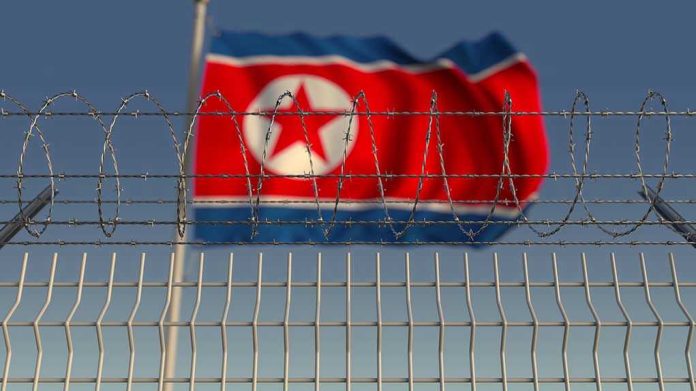
North Korean authorities executed teenagers by firing squad for watching the South Korean drama Squid Game and listening to K-pop, turning public airfields into theaters of terror where schoolchildren were forced to witness executions as ideological lessons.
Story Snapshot
- Three high school students in Hyesan, Ryanggang Province, were executed in early 2026 for watching and distributing South Korean entertainment including Squid Game
- Amnesty International’s February 2026 report based on 25 escapee interviews reveals a systematic campaign of executions and forced labor camp sentences for media consumption
- Wealthy families can bribe officials to avoid punishment while poor teenagers face death or imprisonment, creating a class-based system of enforcement
- Schools force children to attend public executions as warnings, conducting weekly ideological sessions about the dangers of foreign media
- Executions cluster in border provinces near China where USB drives containing banned content are smuggled across the border
When Entertainment Becomes a Capital Crime
The Kim Jong-un regime has transformed media consumption into a death sentence through the 2020 Law on Rejecting Reactionary Ideology and Culture. This legislation criminalizes foreign content as ideological pollution, treating a teenager watching Netflix the same way totalitarian states once treated dissidents distributing underground newspapers. The law’s enforcement has intensified throughout the 2020s as USB drives smuggled from China make South Korean dramas and K-pop accessible in remote border provinces. Authorities view these cultural imports as weapons threatening the regime’s Juche ideology, requiring elimination through the most extreme measures.
The Hyesan Executions and Public Terror
In early October 2025, three high school students in Hyesan gathered to watch South Korean and American dramas, sharing them with classmates through portable devices. Within months, authorities apprehended them for circulating banned content. The regime sentenced them to death on-site at an airfield in Hyesan, where a ten-person firing squad executed them before assembled crowds in early 2026. Witnesses reported authorities fired approximately thirty rounds to ensure death, staging the spectacle to maximize psychological impact on observers. The executions followed a pattern documented across Ryanggang, North Hamgyong, and North Pyongan provinces where smuggled media circulates most freely.
Schools as Indoctrination Centers
North Korean schools function as enforcement arms of the regime’s cultural war. Teachers conduct weekly sessions warning students about foreign media dangers, explaining new laws and consequences in explicit detail. Authorities force entire student bodies to attend public executions, sometimes mobilizing tens of thousands of spectators including elementary and middle school children. Escapee Kim Eunju described the practice as ideological education designed to instill fear: if you watch forbidden content, you will suffer the same fate. Schools also serve as humiliation venues where caught students face public degradation before peers, creating peer pressure against media consumption.
The Wealth Gap in State Terror
The regime’s enforcement system reveals a corrupt class divide that contradicts its socialist rhetoric. Wealthy families bribe officials to spare their children from execution or labor camps, while poor teenagers lacking connections face the full brutality of state punishment. This two-tiered justice system has created a perverse marketplace where survival depends on family resources rather than actual guilt or innocence. Amnesty International documented this pattern across multiple provinces, noting that economic status determines whether a teenager watching BTS receives a warning or a death sentence. The corruption undermines any pretense of ideological purity driving the crackdown.
Precedents and Escalating Violence
The recent executions represent an escalation of a long-running campaign. Radio Free Asia reported a 2021 execution in North Hamgyong Province for distributing South Korean shows. Between 2017 and 2018, authorities conducted public executions in Sinuiju witnessed by tens of thousands for media-related offenses. In 2021, teenagers faced investigation in South Pyongan Province for listening to BTS music. Escapee Kim Joonsik recalled that in the late 2010s, three friends of his sisters received multi-year labor camp sentences for watching Korean dramas. These precedents established the framework, but targeting multiple teenagers specifically for Squid Game consumption marks a new intensity level in the regime’s cultural paranoia.
The Soft Power Threat
South Korean entertainment represents an existential threat to totalitarian control because it offers a window into prosperity, freedom, and normalcy that contradicts state propaganda. K-pop groups like BTS and dramas like Squid Game showcase a vibrant, creative society just across the border, making North Korean deprivation impossible to ignore. The regime understands that cultural influence can undermine political control more effectively than military pressure or economic sanctions. By executing teenagers for media consumption, Kim Jong-un attempts to seal his population from information that might inspire questioning or dissent. The executions acknowledge the power of South Korean soft power while demonstrating the regime’s weakness in confronting it through persuasion rather than violence.
Escapee Testimonies and Verification Challenges
Amnesty International’s February 2026 report relies on interviews with 25 escapees who maintain family connections inside North Korea. These sources provided consistent accounts of execution patterns, forced school attendance at killings, and bribe systems protecting the wealthy. Escapees like Kim Eunju, Kim Joonsik, and Kim Yerim offered detailed testimonies corroborated across multiple provinces and time periods. The regime’s opacity means direct verification remains impossible, as North Korean authorities never confirm or deny such incidents. However, the consistency of accounts across years and regions, combined with Amnesty’s rigorous interview methodology, provides strong evidence of systematic brutality targeting teenagers for media consumption.
The North Korean regime’s willingness to execute children for watching television shows reveals totalitarianism’s ultimate logic: control requires eliminating every space where citizens might encounter alternatives to state ideology. These executions serve as warnings that curiosity itself constitutes a capital offense, that entertainment can justify murder when it threatens power. The tragedy extends beyond individual victims to entire communities forced to witness state violence, creating generations traumatized into submission. As South Korean culture continues spreading globally, the Kim regime’s violent response highlights its fundamental insecurity and the brittleness of systems requiring firing squads to compete with television dramas.
Sources:
North Korea executed teens for listening to K-pop, watching ‘Squid Game’: report – Fox News
N. Korea Executed 3 Teens at Airport for Watching Squid Game – Chosun Ilbo
North Korea executes schoolchildren for watching Squid Game – Sky News
North Korea: People ‘executed for watching South Korean TV’ – Amnesty International