

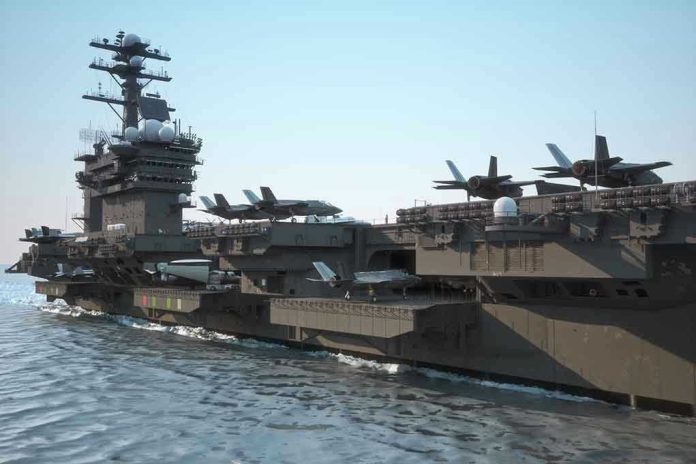
A non-stealth Navy Growler “shot down” America’s invincible $334 million F-22 Raptor in a 2009 training exercise, exposing stealth’s hidden vulnerability to electronic warfare.
Story Snapshot
- EA-18G Growler achieved simulated beyond-visual-range kill on F-22 at Nellis AFB using geometry, awareness, and jamming.
- Growler pilots added F-22 kill marking as morale-boosting joke, confirmed by photo and pilot interview.
- Event highlights EW’s power to disrupt stealth radar and sensors in constrained exercises.
- F-22 remains dominant; this scenario-specific win reinforces joint training value without doctrinal change.
2009 Nellis Exercise: Growler Exploits F-22 Blind Spots
U.S. Navy EA-18G Growler pilots maneuvered into the F-22 Raptor’s rear blind spot during Red Flag at Nellis Air Force Base. They jammed the stealth fighter’s AESA radar and sensor fusion with AN/ALQ-218 receivers and ALQ-99 pods. This allowed an AIM-120 AMRAAM missile lock for a beyond-visual-range simulated kill. The Growler, a 4th-generation platform from the F/A-18F Super Hornet, proved electronic warfare trumps stealth in dense electromagnetic scenarios. Rules of engagement limited F-22 radar use, testing real tactics.
F-22 Raptor: Stealth Pinnacle Meets EW Challenge
Lockheed Martin and Boeing built the F-22 as a 5th-generation air superiority fighter entering service in 2005. It excels in all-weather supersonic operations with low observability. The 2009 event revealed vulnerabilities when jamming degrades its active electronically scanned array radar. Growler’s emissions, however, risk detection by F-22 passive sensors. Experts note F-22 dominance persists in unrestricted beyond-visual-range engagements. This simulated loss underscores no platform operates invincible.
Growler’s Tactical Edge and Navy Morale Boost
Boeing’s EA-18G replaced the EA-6B Prowler in 2009 for suppression of enemy air defenses. Pilots confirmed the AIM-120 shot to journalists at Joint Base Andrews but withheld jamming details. The EA-1 prototype displayed an F-22 kill mark as an inside joke. U.S. Navy crews boosted morale amid inter-service dynamics with Air Force. Nellis commanders set scenarios fostering learning. Common sense affirms such exercises sharpen skills without undermining capabilities.
U.S. Air Force F-22 pilots defended in the exercise, refining tactics against EW. Journalists like Harrison Kass, ex-USAF pilot selectee, analyzed the event without claiming F-22 inferiority.
Expert Views Align on Exercise Realities
Harrison Kass states the win suits specific rules, preserving F-22 doctrine. Aviation Geek Club explains Growler jamming effectiveness but notes stealth fighters track emitters passively. SNAFU! emphasizes tactical geometry over unconfirmed jamming. Ex-Navy Wicklund compares it to WWII training wins by aces. Consensus holds: EW plays decisive role in contested airspace, validating joint ops. American conservative values prioritize proven training over sensational headlines.
Lasting Lessons for Air Superiority
Short-term, Navy gained morale and tactics; long-term, EW integration becomes essential. Precedents like Eurofighter Typhoon’s 2012 within-visual-range wins under constraints affirm exercise benefits. F-22 stays undefeated in combat; Growler fills critical SEAD niche. Politically neutral event stresses funding amid peer threats like China. Stealth evolves against jamming in future fights. No doctrinal shifts occurred; story recirculated in 2026 as historical footnote.
Sources:
Stealth Fighter Down: $334,000,000 F-22 Raptor Was ‘Shot Down’ By U.S. Navy Electronic Warfare Plane
The Truth About the EA-18 Growler Kill on F-22 Raptor
Eurofighter Typhoon Shot Down F-22 Raptor Stealth Fighter